

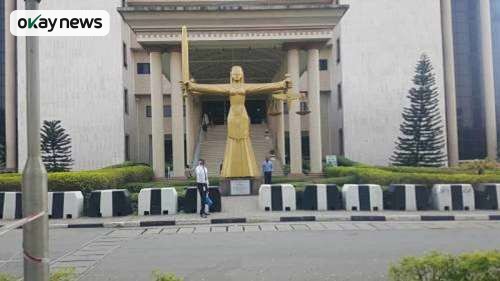
A Federal High Court sitting in Abuja, Nigeria’s capital city and seat of the Federal Government, has ordered the final forfeiture of two large parcels of land originally designated for the Goodluck Jonathan Legacy Model Housing Estate, a residential project intended to serve low-income Nigerians.
The ruling was delivered by Justice Mohammed Umar of the Federal High Court while deciding a motion on notice filed by Nigeria’s Independent Corrupt Practices and Other Related Offences Commission, the statutory anti-corruption agency responsible for investigating public sector corruption. The application was argued before the court by the commission’s legal counsel, Osuobeni Akponimisingha.
Justice Umar issued the forfeiture order without opposition, as the defence counsel, Hassan Liman, Senior Advocate of Nigeria, raised no objection during the proceedings, a development that cleared the way for the court to reach a final determination on the disputed assets.
Okay News reports that the judge further directed the Independent Corrupt Practices and Other Related Offences Commission, acting on behalf of the Federal Government of Nigeria, to supervise the completion of the proposed 962 residential housing units on the forfeited land. The court stressed that the revived project must ultimately benefit the originally intended end users.
To achieve this objective, Justice Umar ordered that the commission work in close collaboration with the Federal Mortgage Bank of Nigeria, Nigeria’s apex housing finance institution and the sole respondent in the suit. The judge emphasized that proper coordination between both institutions was necessary to guarantee transparency and accountability in the allocation of the completed homes.
The properties affected by the forfeiture include Plot Number Five, Cadastral Zone D12, located in the Kaba District of Abuja, measuring approximately 122,015.80 square metres and valued at ₦1.94 billion. Also forfeited is Plot Number Four in the same cadastral zone, measuring about 157,198.30 square metres with an estimated value of ₦3.34 billion. The court declared both properties suspected proceeds of unlawful activity.
Justice Umar also ordered the commission to formally hand over the forfeited lands to the Federal Mortgage Bank of Nigeria, which the court identified as the victim of the alleged unlawful conduct surrounding the housing project. In addition, the judge directed both institutions to constitute a joint committee responsible for overseeing the completion and implementation of the housing estate.
The court recalled that on Wednesday, 9 July 2025, it had earlier granted an interim forfeiture of the lands following an ex parte application by the Independent Corrupt Practices and Other Related Offences Commission. That interim order was made pending the hearing and determination of the substantive suit marked FHC/ABJ/CS/1124/2025.
Documents presented before the court revealed that the lands were originally allocated at no cost by the Federal Capital Territory Administration, the authority responsible for land management in Abuja. The allocation was made to enable the construction of 962 residential units under Nigeria’s National Housing Fund Scheme, a government-backed initiative designed to provide affordable housing for low-income earners, through the Federal Mortgage Bank of Nigeria.
According to an affidavit sworn by an officer of the commission, Iliya Marcus, intelligence reports indicated that the Federal Mortgage Bank of Nigeria had engaged a private real estate developer, Good Earth Power Nigeria Limited, to execute the housing project on its behalf.
The affidavit disclosed that the project received official approval on Monday, 30 July 2012, and was to be developed as the “Goodluck Jonathan Legacy Model Housing Estate,” named after Goodluck Jonathan, who served as President of the Federal Republic of Nigeria from 2010 to 2015.
Further evidence showed that the Federal Mortgage Bank of Nigeria entered into a framework agreement with the developer and secured a $65 million loan facility from Ecobank, a pan-African financial institution headquartered in Lomé, Togo, to finance the construction. The project was designed to benefit low-income Nigerians and was scheduled for completion within eighteen months.
However, investigations by the commission allegedly revealed that the bank paid the entire $65 million project sum to the developer, including a ₦3.78 billion drawdown in November 2012, without evidence of construction progress on the site or compliance with statutory regulatory requirements.
The commission further informed the court that despite the full release of funds, not a single housing unit was constructed on the land. It also alleged that the developer was making moves to dispose of the land to unsuspecting members of the public, an action that could frustrate government recovery efforts.
While granting the earlier interim forfeiture, Justice Umar questioned the rationale behind the upfront payment of the entire project cost without corresponding work on the ground. He stressed the need to protect public assets and ensure that the housing project eventually serves the low-income beneficiaries for whom it was originally conceived.