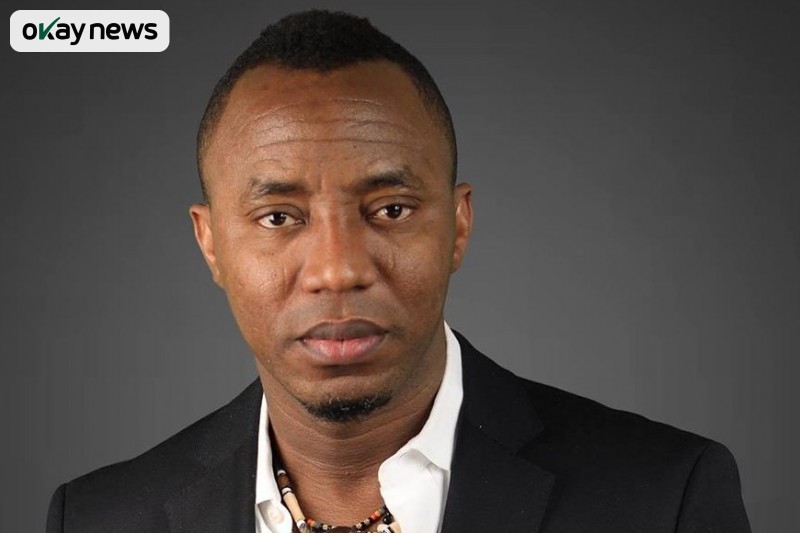
A former presidential candidate and Nigerian human rights activist, Omoyele Sowore, has called for a fundamental rethinking of Nigeria’s national defence structure, proposing the complete removal of the position of Minister of Defence in favour of a technology-driven security framework centred on drone warfare.
Sowore made the remarks during an appearance on Channels Television’s Morning Brief, a flagship political programme aired by Channels Television, one of Nigeria’s leading private broadcast stations, on Monday, January 5, 2026. His comments come amid growing public concern over persistent insecurity across several regions of Africa’s most populous country.
Okay News reports that Sowore strongly criticised what he described as outdated military procurement systems and excessive bureaucratic layers, arguing that they have limited Nigeria’s ability to respond swiftly and efficiently to security threats such as kidnappings, armed banditry, and insurgency.
“If I’m president of Nigeria, I’m not buying any jet anymore. I’m buying unmanned aerial vehicles. I want to invest in drones. They are pretty expensive, but they are more effective,” Sowore said.
The former presidential contender explained that unmanned aerial vehicles, commonly known as drones, provide broader surveillance coverage at a significantly lower operational cost compared to conventional fighter jets. According to him, a small team of trained operators can control multiple drones simultaneously, enabling faster response times during security incidents.
“Because you can just have five persons operate ten drones. Even the drones that they buy for two thousand dollars, I have two of them, and they get seized all the time. They can cover a four-kilometre radius within twenty minutes,” he stated.
Expanding on how the technology could address Nigeria’s security challenges, Sowore added, “That is to say, if I have ten unmanned [drones] and I have operators, and I hear there is a kidnapper walking in the bush, I can use that drone to at least track them for a while, until the police can then conduct their cordon.”
He further argued that Nigeria’s terrain makes drone surveillance especially effective, noting that forest density in most regions does not exceed manageable limits for aerial monitoring.
“It can go four kilometres, and there are not too many forests that are longer than, let’s say, ten kilometres in terms of thickness,” he said.
Sowore also highlighted the affordability of scaled drone deployment, suggesting that state governments could significantly improve security coverage by investing in large numbers of relatively inexpensive units.
“And some of these small, inexpensive drones, I’m not saying that’s what you should use, cost you two thousand dollars. And if you buy a hundred of them for a state, you will be doing a marvellous job,” he added.
Nigeria is currently battling multiple security crises, including the Boko Haram insurgency in the North-East region, armed banditry in the North-West, and widespread kidnapping incidents across central and southern parts of the country. While the Federal Government has expanded the use of aerial surveillance, critics continue to point to inefficiencies caused by corruption and administrative delays.
Drawing comparisons with global conflicts, Sowore referenced the use of advanced aerial technology in the conflict involving Israel, a Middle Eastern nation with one of the world’s most advanced militaries, and Iran, a major regional power in West Asia.
“The conflict between Israel and Iran has shown to you that the Air Force is on its way to retirement,” he said.
“You can stay in your country, you can take over my airspace, and I don’t have to have a single jet. I can have your F-35, and if I have very capable drones, I’ll get to you,” Sowore added, referring to the F-35 fighter jet used by the United States and allied nations.
He concluded by reiterating his stance against heavy investment in traditional fighter jets, citing long training periods and supply chain challenges.
“So if you’re still buying some fancy fighter jets that you have to train people for five years to use, you’re not likely to get replacement parts on time; you’re wasting your time. That’s why I said somewhere, if I’m president of Nigeria, I won’t have a minister of defence. My minister of defence would be a drone,” he said.