A former senior official of Nigeria’s election management body has urged President Bola Ahmed Tinubu to decline approval of a newly passed electoral reform bill, warning that it could weaken public trust in the country’s democracy.
Mike Igini, who previously served as Resident Electoral Commissioner in Akwa Ibom State for the Independent National Electoral Commission, the federal body responsible for conducting elections in Nigeria, made the appeal on Wednesday, February 18, 2026, during an interview on Arise Television, a Nigerian news broadcaster.
His comments followed the passage of the Electoral Act 2022 Repeal and Re Enactment Bill 2026 by the Senate, the upper chamber of Nigeria’s National Assembly. The legislation seeks to amend and update Nigeria’s electoral law, but has generated controversy over provisions relating to the electronic transmission of election results.
Clause 60 of the bill addresses how results from polling units are transmitted. Critics argue that changes introduced during Senate deliberations could weaken safeguards intended to guarantee real time electronic transmission of results from polling stations to central databases.
Speaking during the televised interview, Igini appealed directly to President Tinubu, recalling the president’s long history in Nigeria’s pro democracy movement.
“It is indeed my humble recommendation to Mr President that you are a man of history. You were a senior man to very many of us in the struggle at the time when the journey of Nigeria and the prospect of democracy was less certain,” he said.
He also referred to Nigeria’s 2015 general election, widely regarded as a significant democratic milestone because it marked the first time an incumbent president was defeated at the ballot box.
“And also remember that, at a time when the PDP was in office and when we were in office, and they were saying that there was going to be a federal might, some of us stood out to say no.
“In 2015, it’s going to be the might of people, not federal might, but the might of the people through the ballot that should determine what will happen.
“You should be a man of history, what is put before you take it back, don’t sign it,” Igini said.
Okay News reports that the Senate passed the bill on Tuesday, February 17, 2026, after intense debate. During deliberations, Senator Enyinnaya Abaribe, who represents Abia South Senatorial District in southeastern Nigeria, requested a formal division on Clause 60 subsection 3. He argued that manual result forms should not serve as a fallback option where electronic transmission fails.
After voting, 55 senators supported retaining the proviso that allows manual forms as a backup, while 15 senators opposed it.
Beyond the legislative debate, Igini also expressed concern about the role of the judiciary in election related disputes. Nigeria’s courts frequently adjudicate post election challenges, and their rulings can determine the final outcome of contested races.
“The greatest option that we have is the judiciary that must stand tall and mighty in defence of democracy and the rule of law. Were it not for the judiciary, we would not be where we are today,” he said.
However, he criticised past judicial outcomes in electoral matters.
“I have all the records of failures. When it comes to elections, the judiciary has not done well. In fact, the Nigerian people now see my constituency as a veritable conspiracy against them because they have never given effect to it.”
Igini further faulted the Senate’s handling of the bill, pointing to what he described as a reversal of earlier provisions that mandated real time electronic transmission of results from polling units.
“Look at what has happened…Today, no primary in Nigeria because Supreme Court struck down the party direction that was issued in line with Section 29 of the Act,” he said.
He had earlier warned that some members of the National Assembly could risk losing their seats if clear guarantees for real time electronic transmission are not preserved in the law.
For many Nigerians, the debate over electronic transmission of results is central to concerns about transparency and credibility in elections. Civil society groups have long argued that digital transmission reduces opportunities for tampering during the collation process.
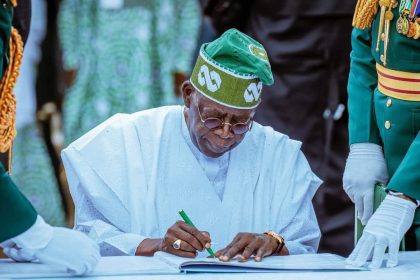
President Tinubu now faces the constitutional decision of whether to sign the bill into law or return it to the National Assembly for further reconsideration.