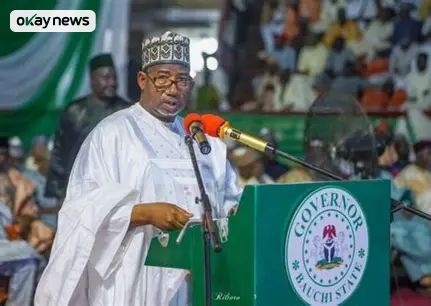
Bauchi, Nigeria – The Bauchi State government has announced plans to spend N112.7 billion on education in 2026, covering primary schools, secondary schools, and universities. Governor Bala Mohammed disclosed the figure at the combined eighth, ninth, and tenth convocation ceremony of Sa’adu Zungur University, Gadau, according to the News Agency of Nigeria.
Okay News reports that the state has consistently allocated over 15% of its annual budget to education, in line with UNESCO’s guidance on sector funding. About N58.02 billion of the 2026 allocation will go to higher education, including N40.6 billion for capital projects such as new classrooms, hostels, laboratories, ICT centres, and staff quarters. The rest will support primary and secondary schools, teacher welfare, learning materials, and basic infrastructure.
The funding will translate into concrete upgrades at Sa’adu Zungur University, including the construction of 20 new classrooms and the expansion of student hostels at the Gadau and Yuli campuses. The state also plans to improve security, maintain regular salary payments for staff, and adjust registration fees to make university access less burdensome. Governor Mohammed reiterated that the government will not tolerate actions that undermine academic standards, including drug abuse and sexual harassment.
Bauchi State faces one of the country’s largest education gaps, with a 2022 report showing that more than 60% of children in the state are out of school, the third‑highest rate in Nigeria. The 2026 allocation is framed as a step toward reducing that number by expanding access, improving classroom conditions, and providing better learning resources. By keeping more children in school and strengthening the quality of teaching, the state aims to build a stronger workforce for the local and national economy.
The investment also fits into the broader challenge facing Sub‑Saharan Africa, where UNESCO estimates a $70 billion annual education‑financing gap. Governments in the region spend far less per learner than high‑income countries, and underfunding risks serious economic losses from early school‑leaving and low‑skill populations. Bauchi’s decision to earmark such a large share of its budget for education signals a deliberate push to close those gaps and lay the foundation for long‑term human‑capital development.