

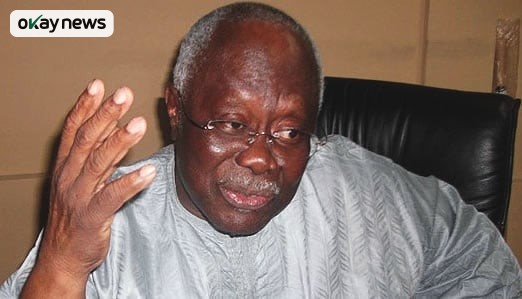
A former Deputy National Chairman of the Peoples Democratic Party, Chief Olabode George, has raised strong concerns over what he described as increasing intolerance for opposition voices in Nigeria, warning that democracy cannot survive without a strong and protected opposition.
Chief George, a prominent Nigerian politician and elder statesman within the Peoples Democratic Party, made the remarks in a statement released on Monday, January 5, 2026, while reflecting on Nigeria’s democratic evolution, recent political tensions, and ongoing economic challenges. Okay News reports that his intervention comes amid growing national debates about governance, federalism, and political pluralism in Africa’s most populous country.
According to George, democracy loses its essence when dissenting voices are suppressed, arguing that the absence of a viable opposition effectively transforms democratic governance into authoritarian rule. He stressed that open political competition remains central to accountable leadership.
“Democracy thrives on a plurality of ideas, not the silence of the graveyard,” George said.
He expressed deep concern over what he termed a growing culture of intolerance toward political dissent, noting that recent developments suggest shrinking space for opposing viewpoints within Nigeria’s political landscape.
George specifically referenced reported acts of harassment against Governor Bala Mohammed of Bauchi State, a state in northeastern Nigeria, and Governor Seyi Makinde of Oyo State, a state in southwestern Nigeria. He warned that such actions pose a serious threat to Nigeria’s federal structure, which is designed to protect the autonomy and authority of subnational governments within the federation.
“The harassment of these governors is not a mere political skirmish; it is a calculated assault on federalism,” he said.
According to the former Deputy National Chairman, intimidation of elected governors for expressing dissenting political views signals a dangerous drift toward authoritarian governance, a development he warned could weaken democratic institutions across the country.
George further cautioned that policies or actions perceived as deliberately undermining opposition parties could erode public confidence in Nigeria’s democratic system and create long-term instability.
Reflecting on leadership responsibility, he emphasized that effective governance must be rooted in service, sacrifice, and respect for democratic norms, rather than the pursuit of unchecked power.
Turning to electoral integrity, George urged the Chairman of the Independent National Electoral Commission, Nigeria’s constitutionally empowered body responsible for conducting elections, to uphold transparency and fairness in future polls.
“The credibility of our democracy rests squarely on INEC. The era of miracle results and technical glitches must end,” George said.
On economic matters, George also warned the Federal Government of Nigeria against tax policies that could further burden citizens and businesses already grappling with economic hardship.
“While revenue generation is important, it must not come at the cost of the people’s survival,” he said.
Drawing lessons from international experience, he cited Venezuela, a South American nation rich in oil resources, as an example of how excessive taxation combined with suppression of opposition voices can destabilize even resource-rich countries.
“Venezuela reminds us that when leadership prioritizes power over the people, nations crumble,” George said.
He concluded by calling on Nigeria’s political leaders to protect democratic institutions, respect opposing views, and prioritize the welfare of citizens, warning that the country’s future depends on these choices.
“The soul of our nation depends on it,” he said.