


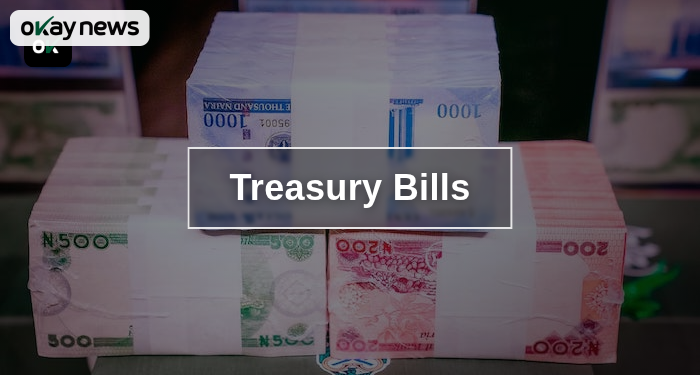
Abuja, Nigeria – The Central Bank of Nigeria has announced plans to raise N850 billion ($564 million USD) through a fresh Treasury Bills auction scheduled for March 11, 2026. This will bring the total amount raised within one week to approximately N2 trillion ($1.3 billion USD).
Okay News reports that the official tender notice was mailed to primary market dealers by the apex bank on behalf of the Debt Management Office. The planned auction comes barely one week after the Central Bank conducted a Treasury Bills sale on March 4, where it raised N1.01 trillion from investors following strong demand for government securities.
The auction notice indicates that the Federal Government will offer N850 billion worth of Treasury Bills across three tenors. N100 billion will be offered in 91-day Treasury Bills, N150 billion in 182-day Treasury Bills, and N600 billion in 364-day Treasury Bills. The sale will be conducted using the Dutch auction system, with settlement scheduled for the next day.
Prospective investors must submit bids electronically through the Central Bank’s Scripless Securities Settlement System between 8:00 a.m. and 11:00 a.m. on Wednesday, March 11, 2026. Each bid must be submitted in multiples of N1,000, subject to a minimum subscription of N50,001,000. Authorized Money Market Dealers may submit multiple bids for their own accounts, for non-money market dealers, or for interested members of the investing public.
Successful bidders will receive allotment letters on Thursday, March 12, 2026. Payments are required no later than 11:00 a.m. through accounts held with the apex bank.
The planned auction follows the Treasury Bills Primary Market Auction held on March 4, where the Central Bank offered N1.05 trillion across the same three tenors. Investors significantly repriced the short and longer tenors despite N2.34 trillion in total oversubscriptions.
The 364-day bill dominated demand, attracting N2.13 trillion in bids against N800 billion offered. The apex bank eventually allotted N1.01 trillion across all tenors. Stop rates settled higher at 15.95% for the 91-day bill and 16.73% for the 364-day bill, while the 182-day bill remained flat at 16.65%.
The one-year instrument recorded the sharpest increase in yield, rising by 0.83 percentage points from the previous auction. Despite strong oversubscription at the long end of the curve, the bill recorded the highest repricing and relatively higher returns.
The Treasury Bills auction process is fully digitalized through the Central Bank’s Scripless Securities Settlement System. This platform facilitates bid submission, allocation, and settlement within a unified electronic framework. The system reduces operational errors and enhances transparency in the primary market for government securities.
Under the Dutch auction system, pricing reflects actual investor demand rather than fixed rates. Successful bidders receive allocations based on the yields they are willing to accept. Investor demand patterns from the previous auction signal a push for higher interest rates despite strong liquidity conditions in the financial system.
Treasury Bills remain one of the Federal Government’s primary tools for short-term borrowing and liquidity management. Market participants will closely monitor the March 11 auction to determine whether yields may continue to trend higher, particularly on longer-tenor instruments.


 through a fresh Treasury Bills auction scheduled for March 11, 2026. This will bring the total amount raised within one week to approximately N2 trillion ($1.3 billion USD).)