


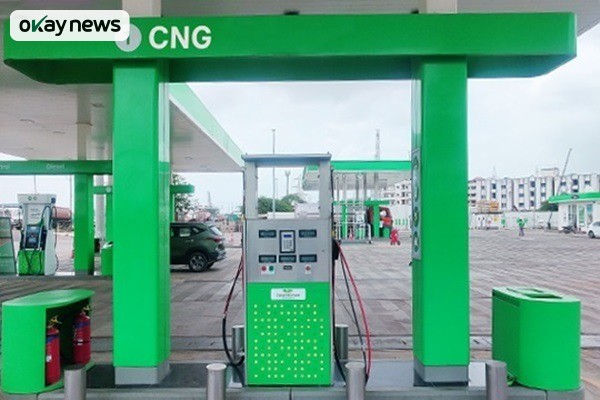
Abuja, Nigeria – Nigeria’s rollout of Compressed Natural Gas (CNG) stations and conversion centres is falling short of its 2025 targets despite securing more than $2 billion in private sector investments over two years, raising fresh concerns about implementation gaps.
Okay News reports that checks by government agencies and industry stakeholders reveal that while funding inflows and policy backing remain strong, on-the-ground delivery of refuelling stations and nationwide access appears slower than earlier projections. The Presidential CNG Initiative was introduced in 2023 as a core energy transition response to petrol subsidy removal, with ambitious plans to scale gas powered mobility nationwide.
In January 2025, Programme Director Michael Oluwagbemi announced plans to have at least 500 conversion centres and over 150 CNG retail outlets by year end. However, clear data confirming progress toward that benchmark remains limited. Checks on the initiative’s website indicate that more than 300 conversion centres and over 40 refuelling stations have been built since 2023, but there is no year by year breakdown showing how many were actually delivered in 2025. As of January 2025, when the announcement was made, there were about 50 CNG refuelling stations and 193 conversion centres across Nigeria, demonstrating a significant gap between projections and current coverage.
Requests for detailed performance data were redirected between agencies. Lara Obileye, Sales, Business Development and Strategy Manager for the initiative, referred inquiries to the Federal Ministry of Finance and the Nigerian Midstream and Downstream Petroleum Regulatory Authority. Dr. Ogho Okiti, Special Adviser to the Minister of Finance, said the CNG initiative office should provide the relevant details. A source at the Federal Ministry of Finance described the ministry’s mention as a possible deflection of responsibility.
Industry stakeholders say visible infrastructure rollout has lagged behind official projections, particularly in nationwide coverage. Audu Maiturare of the National Union of Road Transport Workers in Nyanya said drivers cannot risk being stranded if stations are only available in a few corridors. Ben Ngilari, an Abuja based commercial transporter, added that until refuelling points are reliably available across states, large fleet migration will remain limited. Sector operators also cite bottlenecks including delays in equipment importation, limited local manufacturing capacity for cylinders and conversion kits, regulatory approval timelines, logistics constraints, uneven state level coordination, and limited financing access for small conversion centres.
The CNG initiative is central to the Federal Government’s broader strategy to reduce transport fuel costs and ease pressure on foreign exchange by shifting demand toward domestically available natural gas. Policymakers positioned CNG as a cheaper and cleaner alternative for mass transit operators following fuel price deregulation.
Programme projections indicate more than $2 billion in private investment commitments have already been secured, with expectations of reaching $5 billion by 2027. Government allocations have included N100 billion approved in late 2023, N130 billion in the 2024 budget, and N225 billion in the 2025 budget cycle.
With 2025 now over, infrastructure delivery rather than funding announcements is becoming the key performance metric. Energy analysts note that while investment commitments are strong, execution speed and transparent milestone reporting will ultimately determine whether the initiative achieves its cost reduction and energy transition objectives.
 stations and conversion centres is falling short of its 2025 targets despite securing more than $2 billion in private sector investments over two years, raising fresh concerns about implementation gaps.)