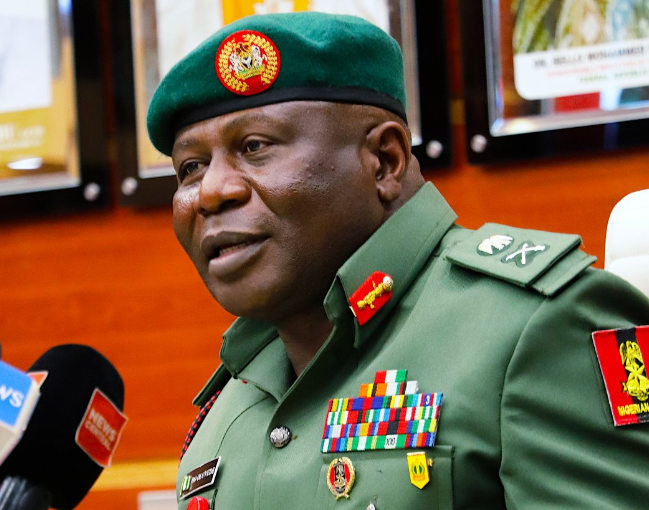
The Chief of Army Staff, Lieutenant General Olufemi Oluyede, has urged residents of Imo State to stop shielding or supporting criminal elements within their communities, stressing that such actions undermine peace and stability.
Okay News reports that the Army Chief made this call during a stakeholders’ forum with the theme “Taking the Nigerian Army to the Communities,” held on Thursday in Owerri, the Imo State capital.
Represented by Major General Obinna Ajunwa, Oluyede emphasized the need for a strong partnership between citizens and security agencies to tackle insecurity. He warned that tolerating or hiding criminals would only worsen the security challenges facing the region.
“What you condone is what you tolerate, and what you tolerate is what will destroy you,” Ajunwa cautioned.
He assured residents that the Nigerian Army would continue to engage with communities and gather feedback to strengthen its operations nationwide. Oluyede further noted that most of Nigeria’s security threats are internal rather than external, which makes community cooperation indispensable.
In his remarks, the Chief of Civil–Military Affairs, Major General Gold Chibuisi, said the forum was one of the Army’s non-kinetic strategies aimed at fostering public confidence and collaboration. He described insecurity as an evolving challenge that requires every Nigerian’s involvement.
“While the Nigerian Army and other security agencies are the first responders, winning the war against insecurity demands collective responsibility from all law-abiding citizens,” Chibuisi added.
Chairman of the Imo State Council of Traditional Rulers, Eze Emmanuel Okeke, applauded the initiative, describing it as timely and crucial for promoting community safety. He reaffirmed the traditional institutions’ readiness to work hand in hand with security operatives.
Also speaking, the Acting Chairman of the Christian Association of Nigeria (CAN), Imo State chapter, Rev. Uzoma Uzoeshi, outlined seven measures to strengthen peace efforts. These include enhanced youth empowerment, fair justice systems, interfaith dialogue, improved surveillance, community engagement, and continuous collaboration among all sectors.