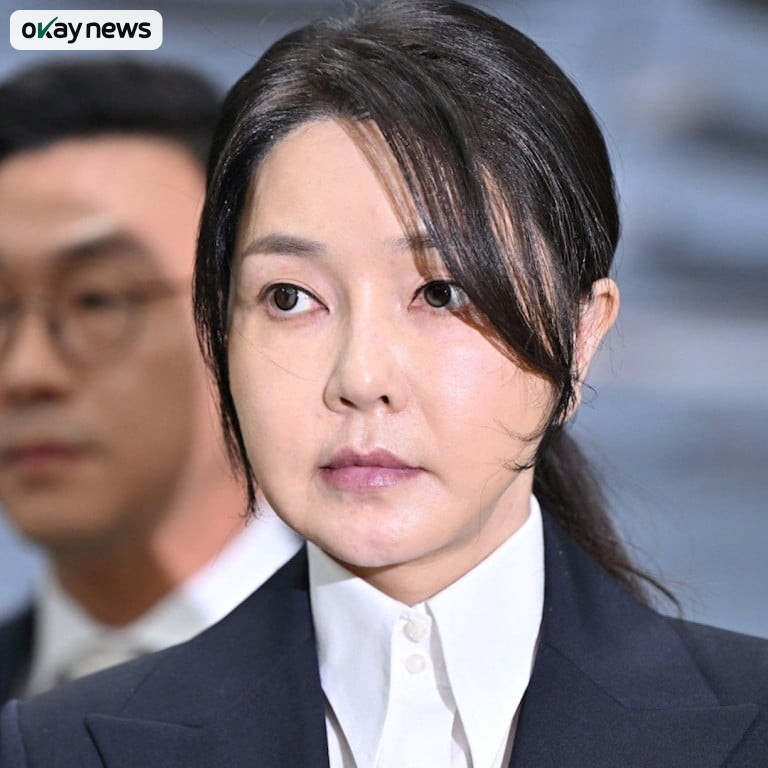
A court in South Korea, officially the Republic of Korea, has sentenced former first lady Kim Keon Hee to 20 months in prison after finding her guilty of accepting expensive gifts linked to the Unification Church, a controversial religious movement that has operated internationally for decades.
The ruling on Wednesday, 28 January 2026, was delivered by Judge Woo In-sung at the Seoul Central District Court in Seoul, South Korea’s capital. The court convicted Kim of corruption but cleared her of separate allegations including stock manipulation and breaches of election funding rules.
Okay News reports that the case is the latest legal blow for Kim and her husband, impeached former South Korean President Yoon Suk Yeol, with both now in custody. Yoon is facing detention over actions connected to his declaration of martial law in December 2024, a move that triggered a major national crisis and multiple investigations.
In court, Kim was found to have taken luxury items presented as bribes from individuals linked to the Unification Church. The items cited included a Chanel bag and a Graff necklace, according to the judgment.
Prosecutors had asked the court to impose a much tougher punishment of 15 years in prison. However, the court imposed a shorter sentence after acquitting her of other charges brought alongside the corruption case.
While delivering the verdict, Judge Woo said Kim’s closeness to the president gave her “significant influence,” and the court concluded she took advantage of that position. He added: “One’s position must never become a means of pursuing private gain.”
Kim appeared in court as the sentence was read, dressed in black and wearing a white face mask and glasses.
After the ruling, Kim released a statement apologising for “the concern” she may have caused and said she accepted the court’s “stern criticism.” Her legal team said she had not yet decided whether she would appeal.
Prosecutors, however, strongly disagreed with the outcome. They described the decision as difficult to accept and said they would appeal the sentence.
At a final hearing in December 2025, prosecutors argued that Kim acted as if she was above the law and accused her of working with the Unification Church in ways that weakened the constitutional separation of religion and state. One of the prosecutors, Min Joong-ki, said at the time that South Korea’s institutions were “severely undermined by abuses of power” linked to Kim.
Kim has previously denied wrongdoing. In her final testimony last month, she described the allegations against her as “deeply unjust.”
Despite the conviction, Kim is still facing two more trials. Those cases involve fresh bribery allegations and claims she violated South Korea’s Political Parties Act. Prosecutors allege she helped arrange the mass enrolment of more than 2,400 Unification Church followers into Yoon’s conservative People Power Party.
Kim’s legal troubles have followed years of public controversy during Yoon’s presidency. The 53-year-old, known for her public support for animal welfare and efforts to campaign against the dog meat trade, often became a focal point of political debate, with accusations ranging from influence peddling to questions about her past academic claims.
In 2023, hidden camera footage emerged that appeared to show Kim accepting a $2,200 luxury handbag, an incident that later became widely referred to as the “Dior bag scandal.” The political fallout from that scandal added to pressure on Yoon’s administration and was seen as one factor behind his party’s poor performance in South Korea’s parliamentary elections in April 2024, when it failed to regain a majority.
Yoon later vetoed three opposition-backed bills seeking investigations into allegations involving Kim, including the Dior bag case. His last veto came in November 2024, and he declared martial law about a week later.
Kim’s conviction also comes amid wider prosecutions tied to the fallout from the martial law episode. Days before her sentencing, former South Korean prime minister Han Duck-soo was sentenced to 23 years in prison for aiding and abetting Yoon’s suspension of civilian rule. In January 2026, Yoon was sentenced to five years in prison for obstructing justice and other offences in the first of several trials connected to the martial law declaration.
Investigations linked to Kim’s case have also reached senior figures connected to the Unification Church. The probe led to the arrest of Han Hak-ja, the church’s leader, as authorities widened their focus to alleged bribery networks and political funding claims.
Also on Wednesday, 28 January 2026, the Seoul Central District Court sentenced Yun Young-ho, a former Unification Church official, to 14 months in prison for offering luxury gifts to Kim and providing illegal political funds to a lawmaker.
In the same set of rulings, opposition lawmaker Kweon Seong-dong, described as an ally of former president Yoon, was sentenced to two years in prison for receiving 100 million won ($70,000) from the sect.