


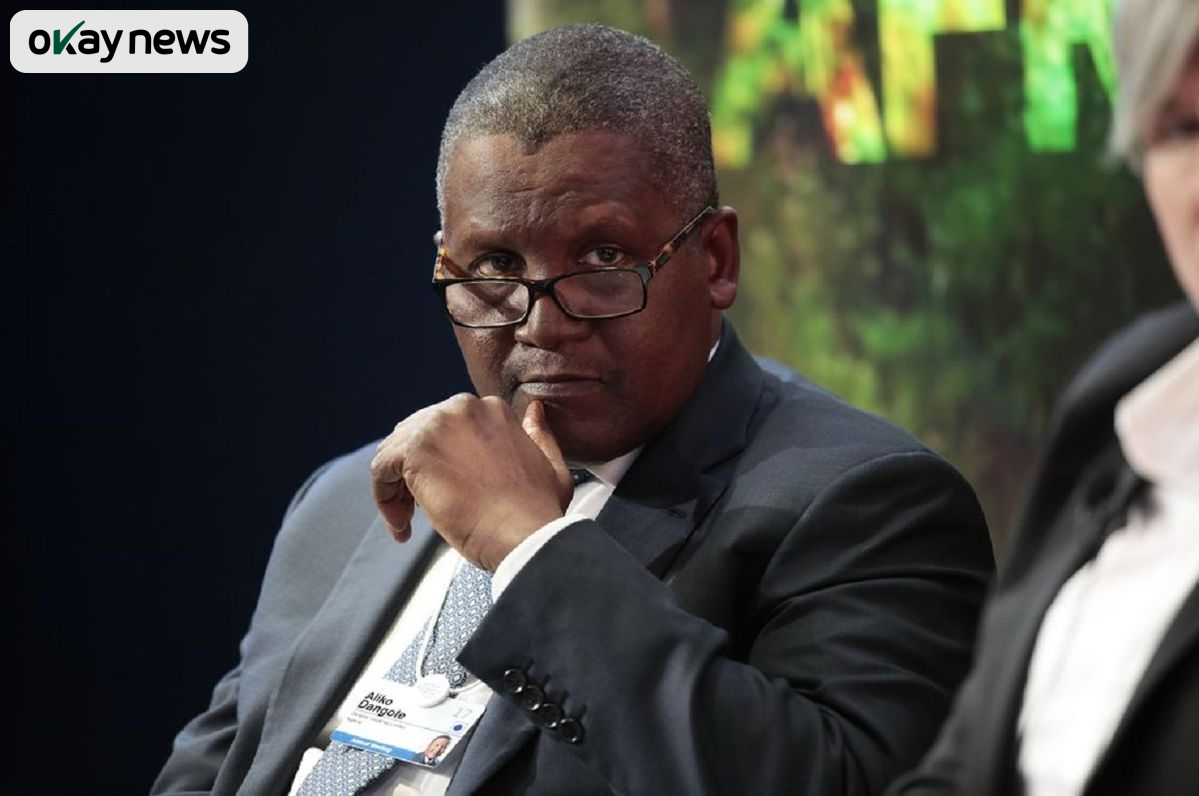
The President/Chief Executive Officer of the Dangote Group, Aliko Dangote, has called for accountability over allegations that the Chief Executive of the Nigerian Midstream and Downstream Petroleum Regulatory Authority (NMDPRA), Engr. Farouk Ahmed spent $5 million on the secondary school education of four of his children in Switzerland.
Okay News reports that Dangote made the remarks during a media briefing on challenges in Nigeria’s downstream oil and gas sector on Sunday, December 14, 2025, at Dangote Refinery at Ibeju-Lekki, Lagos. He linked the issue to broader concerns about governance, regulatory credibility, and investment in the sector.
Dangote Questions Source Of Funds
Dangote questioned how a public official could afford such extravagant spending and contrasted it with the financial struggles of ordinary Nigerians. He stated that he doesn’t understand why the country should continue to allow corrupt government officials to try and destroy a whole sector of the economy.
The businessman revealed that the secondary school education, which is six years, costs Nigeria $5 million for four children. He noted that even his own children did not attend such expensive schools, as they went to Nigerian secondary schools instead.
Dangote argued that Engr. Farouk Ahmed’s income cannot reasonably cover $5 million in school fees for his children. He stressed that even taxpayers with significant income would have to account for such expenditures, adding that if he were paying $5 million for six years for his own children, the taxman would have to look at his taxes.
Dangote highlighted the contrast between Ahmed’s spending and the realities faced by many Nigerians in Sokoto, his state of origin. Many struggle to pay just N100,000 for secondary school fees, leaving numerous children out of school. He noted that such disparities increase public resentment and weaken trust in government.
Calls For Code Of Conduct Bureau Investigation
Dangote called for an investigation from the highest authorities, referring to the Code of Conduct Bureau (CCB), noting that public officials are required to declare their assets. He stated that Ahmed has to be charged to the CCB because they have his returns, adding that he must have filed and registered what he had.
He reiterated his position that the scale of the alleged school fees is not consistent with a lifetime public service career. He said he is prepared to publicly release details of the school fees if the allegations are denied, stating that when Ahmed denies it, he will publish it with his name.
Dangote also accused Ahmed of a fundamental conflict of interest, saying that a regulator should never act as a trader in the same sector. He argued that during the previous administration, allowing a trader to serve as a regulator created systemic problems in Nigeria’s downstream oil and gas industry.
Under Nigerian law, CCB requires every public officer to declare all their assets, liabilities, and property when they take office, then again at intervals during their tenure and when they leave office. This declaration is intended to ensure transparency and prevent illicit enrichment and abuse of office.
Sanctions for asset non-disclosure or false declaration can include vacation of office, disqualification from holding public office for up to ten years, forfeiture of improperly acquired assets, and prosecution.
, Engr. Farouk Ahmed spent $5 million on the secondary school education of four of his children in Switzerland.)