…Commends Tinubu’s reforms, projects $55bn annual revenue
…Plans NGX listing to empower Nigerians
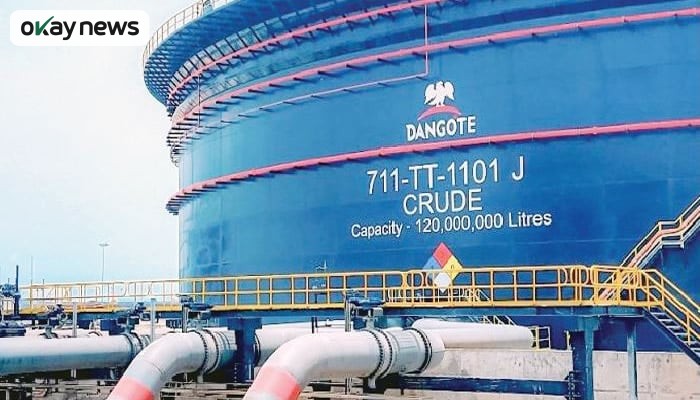
Okay News reports that the President of Dangote Industries Limited, Aliko Dangote, has announced plans to expand the Dangote Petroleum Refinery from its current 650,000 barrels per day (bpd) capacity to 1.4 million bpd, positioning it as the largest refinery in the world.
Speaking at a media briefing in Lagos, Dangote said the decision was influenced by Africa’s growing demand for cleaner fuels and Nigeria’s favourable policy environment that promotes local refining. He explained that the $20 billion facility, which is already the world’s largest single-train refinery, would more than double its output within three years.
“This expansion reflects our confidence in Nigeria’s future, our belief in Africa’s potential, and our commitment to building energy independence for our continent,” Dangote said. “It is the dream of President Bola Ahmed Tinubu for Nigeria to emerge as one of the world’s leading suppliers of petroleum products. With his strong backing through progressive policies, we are taking on the challenge to make this happen.”
He added that the expansion project demonstrates the company’s belief in Africa’s ability to transform from an exporter of crude oil to a hub for refined petroleum products. The project will be funded through cash flow, public listing, and strategic investments.
When completed, the refinery will surpass India’s Jamnagar Refinery to become the world’s largest. Dangote disclosed that the facility will also increase its polypropylene production capacity from 900,000 metric tonnes to 2.4 million metric tonnes annually, alongside expanded production of linear alkylbenzene and base oils.
“With this expansion, the refinery transitions from producing Euro V to Euro VI fuel standards, meeting the highest global environmental benchmarks,” he said. “We will also expand our power generation capacity to 1,000 megawatts, ensuring complete operational self-sufficiency. More than 85% of our workforce will be Nigerian, with continuous investment in skills development and technology transfer.”
Dangote highlighted that the expansion would strengthen Nigeria’s energy security, reduce foreign exchange spending on fuel imports, and save the country billions of dollars yearly.
He projected the refinery’s annual revenue to exceed $55 billion, describing it as one of Africa’s most valuable industrial assets.
The business mogul also reaffirmed plans to list a portion of the refinery’s shares on the Nigerian Exchange (NGX) within the next year. “Our main listing will be here in Nigeria to give Nigerians value,” he stated. “We want the Dangote Refinery to be the golden stock of the Exchange. Listing outside Nigeria is secondary to us. This is a step toward broader ownership and market transparency.”
He explained that the listing would democratise ownership and enable Nigerians to share in the refinery’s value creation.
“This expansion will create additional jobs, support thousands of SMEs, and deepen our industrial base,” Dangote said. “Our goal has never been just to refine oil, but to refine opportunities for our people. It is a vote of confidence in Nigeria, in the reforms of President Bola Ahmed Tinubu’s administration, and in the ability of Africans to build and manage world-class infrastructure.”
Dangote also expressed appreciation to President Tinubu and the Federal Government for policies like Nigeria’s First, Naira-for-Crude, and the One-Stop Shop initiative, which he said have encouraged investors to embark on transformative projects. He lauded the government’s swift intervention in resolving recent refinery disruptions, describing it as a model of public-private collaboration.
Despite not yet recovering the initial investment in the first phase of the refinery, he said the company is focused on long-term value creation. “Refining is a long-term project. We are expanding because we believe in Africa,” he added.
He also noted that the refinery has stabilised local fuel supply, strengthened the naira, and prevented capital flight. “Nigerians today buy petrol at roughly half the price of what our neighbours pay, and it is even cheaper than in Saudi Arabia,” Dangote said. “Our product meets Euro VI standards and has reduced the dumping of toxic fuel into our market.”
As the festive season approaches, Dangote assured citizens of a steady fuel supply. “Despite an eight percent spike in global oil prices in the last three days, I want to assure Nigerians that there will be no scarcity or price hike during the ember months,” he said. “For the first time in many years, Nigerians can look forward to a Christmas and New Year free of fuel anxiety.”
He commended both the Federal and Lagos State Governments, as well as the refinery’s host community in Lekki, for their support.
“This expansion is not just about capacity; it is about confidence — in our people, in our government, and in our continent,” he noted. “Together, we are building a stronger Nigeria and redefining what is possible for Africa.”
Dangote urged other investors with refinery licences to follow suit in supporting President Tinubu’s vision of making Nigeria the refining hub of Africa.
“When Africa builds its own capacity, it builds its own destiny,” he concluded.