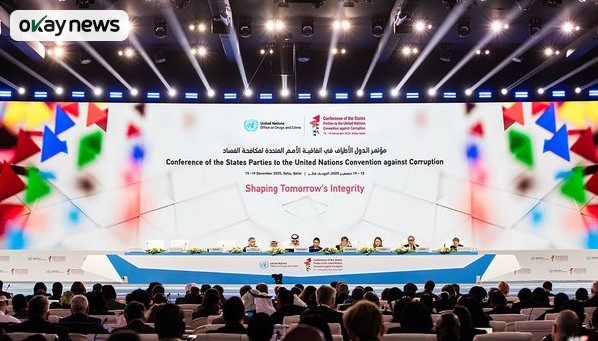
The eleventh Conference of the States Parties to the United Nations Convention against Corruption has concluded in Doha with the adoption of the Doha Declaration 2025, a document that places technology, international cooperation, and institutional integrity at the centre of the global anti-corruption agenda.
Okay News reports that the declaration, adopted at the close of the conference, sends a clear signal that fighting modern corruption requires new tools, deeper cross-border collaboration, and the responsible use of emerging technologies, including artificial intelligence.
In a statement issued after the conference, participants acknowledged that corruption patterns are becoming more complex and transnational, demanding that law enforcement agencies and judicial systems evolve at the same pace.
The declaration calls on states to leverage digital technologies to improve the accuracy, efficiency, and objectivity of corruption risk assessments, while strengthening cooperation between countries.
The declaration also encouraged the use of secure digital platforms developed by expert networks such as the Global Operational Network of Anti-Corruption Law Enforcement Authorities under the United Nations Office on Drugs and Crime, noting that time-sensitive information sharing is critical to preserving the integrity of investigations.
Speaking on the outcome, John Brandolino, Acting Executive Director of UNODC, said the declaration reflects a growing recognition of the role of artificial intelligence in tackling corruption.
He noted that the focus on AI represents “an important recognition of the impact of this technology and a fundamental step toward harnessing its potential in preventing and combating corruption.”
Beyond technology, the conference placed strong emphasis on future generations. The Integrity Advisory Board of the UNODC Youth Initiative called for meaningful youth participation in anti-corruption frameworks and urged governments to actively monitor how commitments made in Doha are implemented.
Delegates also adopted eleven resolutions addressing key global concerns, including transparency in political party and election financing, integrity education for children and young people, the role of corruption in enabling crimes such as migrant smuggling and environmental offences, and reforms to the peer review mechanism of the Convention.
In addition, a separate declaration outlined the next phase of the Convention’s review mechanism, stressing that effective implementation depends on review processes that are efficient, credible, and informed by years of accumulated experience.
The conference also marked a significant step in engaging the private sector. A total of 21 companies joined a newly launched Private Sector Platform, co-led by UNODC and the United Nations Global Compact, aimed at strengthening public-private partnerships in the global fight against corruption.
States Parties further agreed that the twelfth session of the Conference of the States Parties to the United Nations Convention against Corruption will be hosted by Uzbekistan.
The State of Qatar hosted the eleventh session of the conference from December 15 to 19, bringing together more than 2,500 participants from 192 countries.
Attendees included government officials, international and regional organisations, private sector leaders, civil society representatives, and youth delegates, making it the largest global gathering dedicated to promoting integrity, transparency, and accountability.