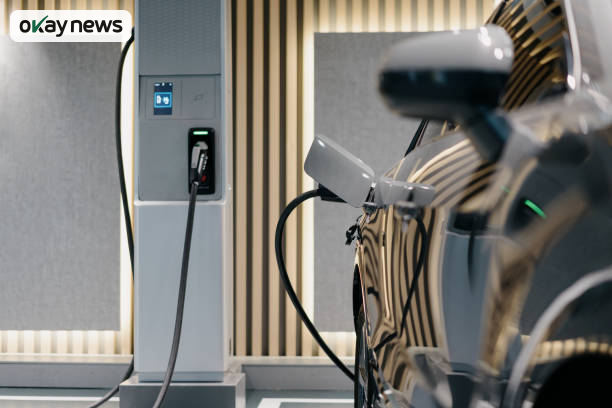
LAGOS, Nigeria — The Federal Government has removed the 5 percent import duty on electric vehicles, triggering projections of lower prices and faster adoption, even as industry players warn of an impending price war that could reshape Nigeria’s emerging electric vehicle market.
Okay News reports that the policy, introduced in mid-April 2026 under the administration of President Bola Ahmed Tinubu, also exempts electric vehicles from green taxes imposed on high-emission vehicles.
Industry stakeholders described the move as a turning point for EV adoption. Olabisi Ajayi, chief executive of an electric vehicle firm, said the policy will open up the middle market. “This is the first time we can confidently say EVs will move from luxury interest to mainstream consideration. Once prices drop, the middle market opens up immediately,” Ajayi said.
Uche Madunagwu, another electric vehicle distributor, said demand is already building. “Ride-hailing companies and logistics firms are already calling. They’ve been waiting for a price trigger like this. We expect demand to spike faster than inventory cycles can adjust,” Madunagwu said. He added: “We are preparing for a price war phase. When duties disappear, the biggest manufacturers win on scale, while smaller dealers must rely on service and relationships.”
Dr. Kaycee Orji, Chairman of Roxettes Group, said the company has championed electric vehicle adoption in Nigeria for several years through Roxettes Motors. He warned that without a clear transition strategy, Nigeria risks becoming a dumping ground for used internal combustion engine vehicles from countries enforcing strict phase-out timelines.
“The idea is to send a signal that Nigeria is not a dumping ground for used ICE vehicles from countries that are moving away from them,” Orji said. He added that the legislation also aims to protect local investors by discouraging indiscriminate licensing of foreign electric vehicle assemblers without strong local partnerships.
Engr. Raheem Adebolu, an Abuja-based automotive specialist, commented: “Removing import duties instantly changes the price structure. That’s a demand shock. But without strong local production incentives, it can easily become an import-dominated market.”
Aminu Gambari, an electric vehicle charging station operator, said infrastructure providers are planning for a significant jump in demand within 12 to 24 months. “The biggest constraint will not be vehicles, it will be electricity access points,” Gambari said.
Nigeria’s passenger car imports rose to N1.58 trillion in 2025, according to the National Bureau of Statistics (NBS) .