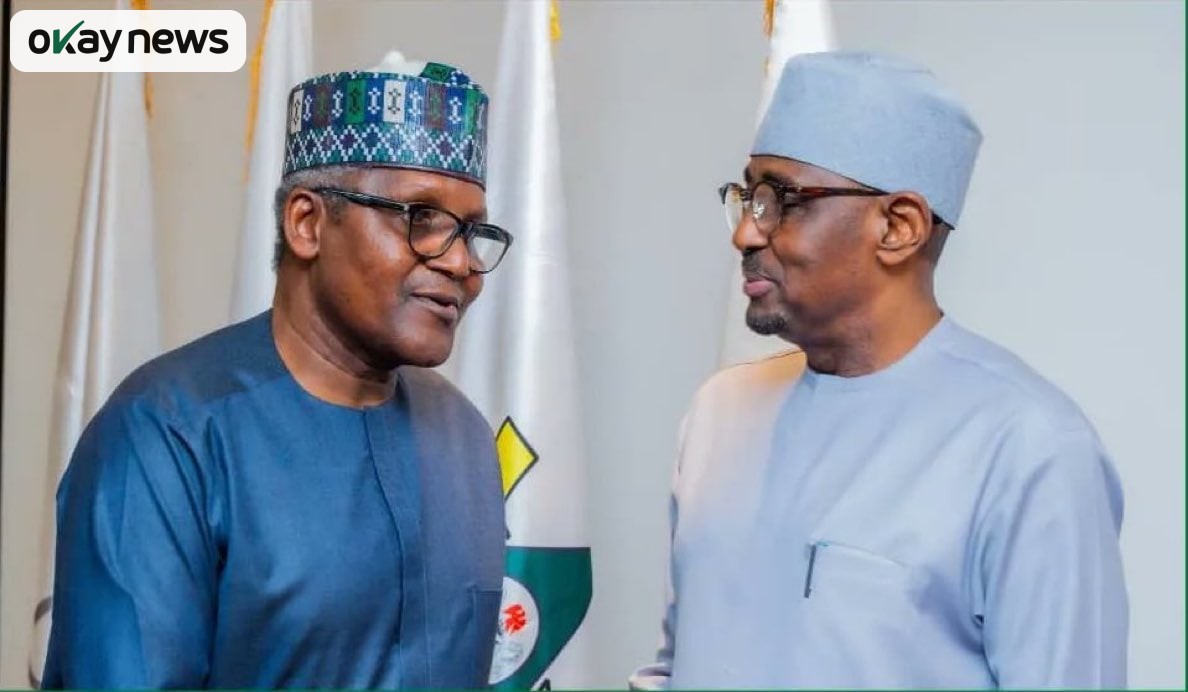
Aliko Dangote, Africa’s richest businessman and Chairman of Dangote Industries Limited, a Nigerian multinational conglomerate with interests spanning cement, sugar, fertilizer, and oil refining, has formally submitted a corruption petition against Farouk Ahmed, the former Chief Executive Officer of the Nigerian Midstream and Downstream Petroleum Regulatory Authority, to Nigeria’s Economic and Financial Crimes Commission.
Okay News reports that the petition was filed through Dangote’s legal representative at the headquarters of the Economic and Financial Crimes Commission, Nigeria’s federal agency responsible for investigating and prosecuting economic and financial crimes, including corruption and money laundering.
The move followed the withdrawal of an earlier version of the petition from the Independent Corrupt Practices and Other Related Offences Commission, another Nigerian anti-corruption agency. According to the petition, the decision to redirect the case to the Economic and Financial Crimes Commission was taken to ensure a faster and more effective investigative and prosecutorial process.
The petition, signed by Lead Counsel, Dr. O.J. Onoja, Senior Advocate of Nigeria, called on the Economic and Financial Crimes Commission to probe allegations of abuse of office, corrupt enrichment, and financial misconduct against Mr. Ahmed. The document stated that Dangote Industries Limited is prepared to submit documentary and financial evidence to support the claims.
“We make bold to state that the commission is strategically positioned along with sister agencies to prosecute financial crimes and corruption related offences, and upon establishing a prima facie case, the courts do not hesitate to punish offenders. See Lawan v. F.R.N (2024) 12 NWLR (Pt. 1953) 501 and Shema v. F.R.N. (2018) 9 NWLR (Pt.1624)337.”
Dr. Onoja further urged the commission, under the leadership of its Executive Chairman, Olanipekun Olukoyede, to take decisive action on the allegations. He stated, “…to investigate the complaint of Abuse of Office and Corruption against Engr. Farouk Ahmed and to accordingly prosecute him if found wanting”.
The petition also emphasized the broader public interest implications of the case, stating that: “The commission’s firm resolve in handling this matter with dispatch is not only imperative and expedient but will also serve as a deterrent to other public officers out there with such corrupt proneness and tendencies”.
The latest development underscores Dangote’s public stance on transparency and accountability within Nigeria’s oil and gas regulatory framework, particularly at a time when the country is attempting to restore investor confidence in its energy sector.
It will be recalled that on Sunday, December 14, 2025, Dangote publicly raised concerns about Mr. Ahmed’s financial lifestyle, alleging that it was inconsistent with his known earnings as a public servant. He claimed that four of Mr. Ahmed’s children attended elite private secondary schools in Switzerland, with costs amounting to several millions of United States dollars.
According to Dangote, the schools attended were Montreux School for Faisal Farouk, Aiglon College for Farouk Junior, Institut Le Rosey for Ashraf Farouk, and La Garenne International School for Farhana Farouk. He stated that each child spent approximately six years in these institutions.
Dangote estimated that annual tuition fees, travel expenses, and living costs per child averaged $200,000, bringing the total secondary education expenditure for the four children to about $5,000,000.
In addition to the secondary school costs, Dangote alleged that a further $2,000,000 was spent on tertiary education for the children, including $210,000 for Faisal Farouk’s Master of Business Administration programme at Harvard University in the United States in 2025.
“Nigerians deserve to know the source of these funds, especially when many parents in Mr. Ahmed’s home state of Sokoto struggle to pay as little as ₦10,000 in school fees,” Dangote stated.
The petition concluded by calling for a comprehensive and transparent investigation, stressing that accountability is essential to restoring public trust in Nigeria’s petroleum regulatory institutions.