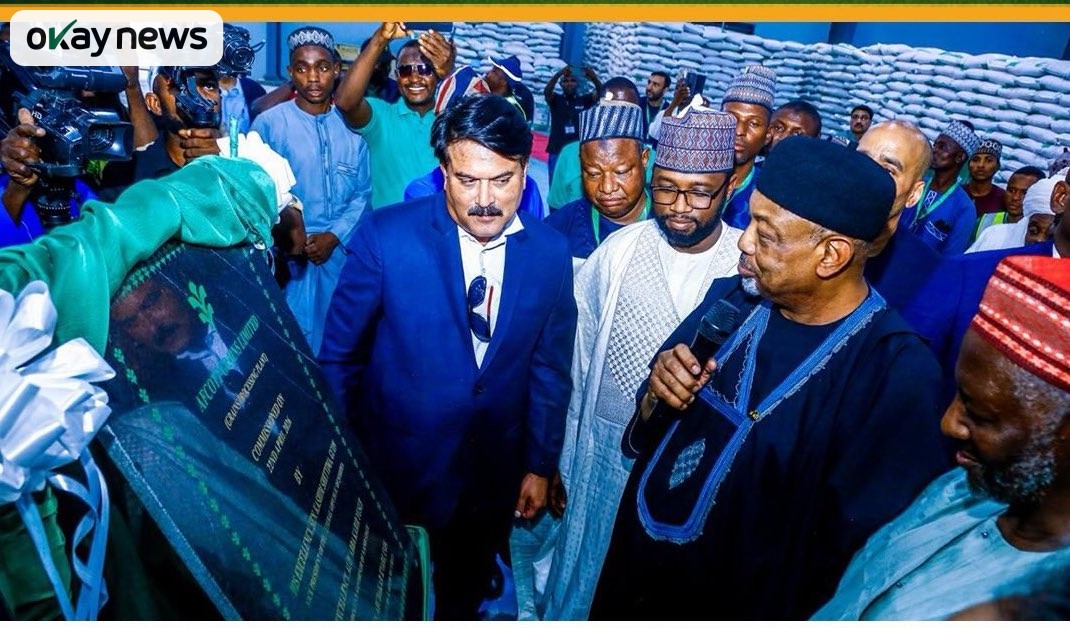
KAWAKIN TOFA, Kano — The Federal Government has opened discussions with Springfield Agro Limited to create long-term financing for nationwide agricultural mechanisation, as Vice President Kashim Shettima commissioned a 40,000-tonne annual sesame processing facility in Kano State on Monday, April 27, 2026, signalling a fresh push toward food self-sufficiency and export expansion.
Okay News reports that Vice President Shettima, represented by Minister of Agriculture and Food Security, Abubakar Kyari, said the Afcott Grains-Sesame and Grains Processing Facility at Kawakin Tofa Local Government Area represented a deliberate effort to match food production with industrial processing.
“Agricultural transformation rests on three critical pillars: inputs, mechanization, and processing. While the Springfield Agro Crop Protection facility strengthens input availability, and Afcott Grains expands value addition and processing capacity, mechanization remains essential to scaling productivity nationwide,” Shettima said.
The Vice President disclosed that following a proposal for structured long-term financing, the presidency is engaging with Springfield Agro to equip all 774 local government areas with tractors and ease upfront costs for farmers. Under the Green Imperative Programme, the Federal Government has already begun mechanisation support across the country.
Shettima praised the Kewalram Chanrai Group, parent company of Afcott Grains, for its “enduring commitment to Nigeria” and noted that the group’s Springfield Agro Crop Protection Chemical Plant, commissioned last year, has since produced over 15 million litres of crop protection solutions, cutting reliance on imports.
Kano State Governor, Abba Kabir-Yusuf, represented by Chief of Staff Suleiman Wali, said the state has invested heavily in agricultural mechanisation, extension services, and irrigation infrastructure in line with the Renewed Hope Agenda.
Vice Chairman, Kewalram Chanrai Group, Navin Chanrai, said the facility was designed to produce 40,000 tonnes of sesame seeds and 25,000 tonnes of other grains annually, with the project completed in 12 months. It will create over 500 direct and indirect jobs, with at least 70 percent of the workforce drawn from Kano State.