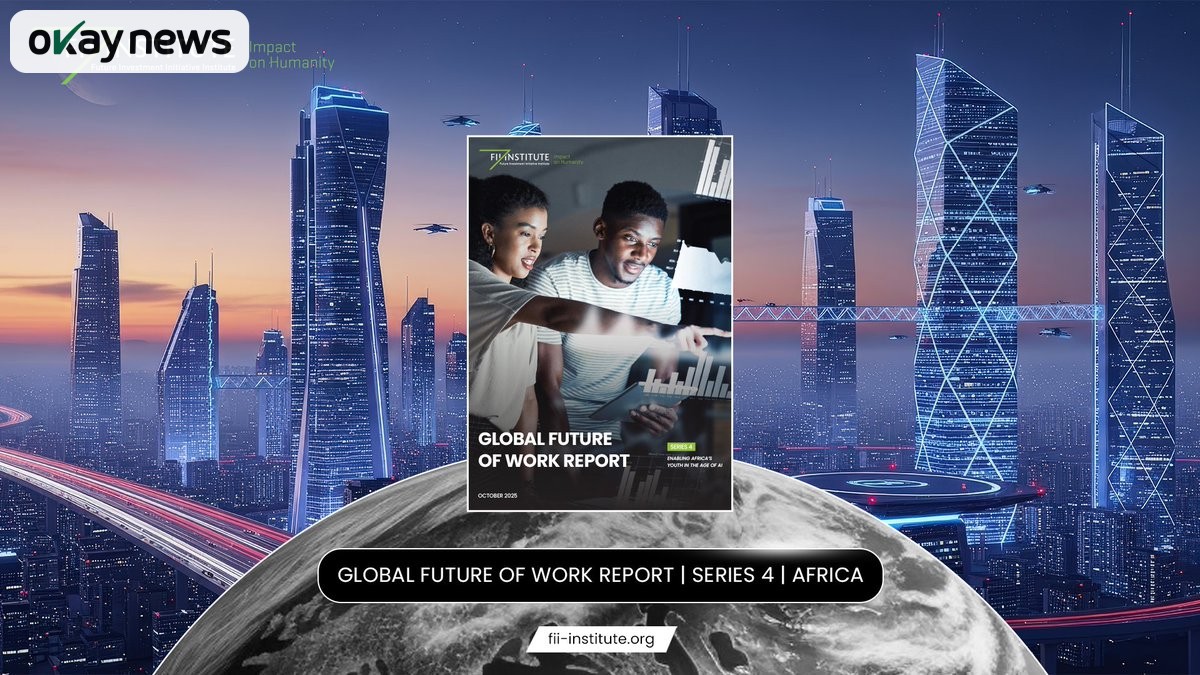
RIYADH — The Future Investment Initiative (FII) Institute has unveiled a sweeping analysis of sub-Saharan Africa’s economic transformation, identifying four distinct categories of countries shaping the continent’s labor and productivity landscape. The new report, titled “Global Future of Work Report: Series 4 – Enabling Africa’s Youth in the Age of AI,” offers a detailed roadmap for unlocking Africa’s potential in the era of artificial intelligence.
According to the FII Institute, Africa’s workforce is projected to expand by 650 million people by 2050, making the region the fastest-growing labor market in the world. Yet, the report warns that this “youth bulge” could either become a demographic dividend or a major economic strain if structural barriers such as low productivity, poor education quality, and informality remain unaddressed.
The FII Institute, working with McKinsey & Company as a knowledge partner, classifies the 49 sub-Saharan countries into four economic segments based on their human capital, digital readiness, governance, and investment attractiveness. The categories — Decelerating Frontrunners, Dynamic Growers, Underleveraged Economies, and States in Transition — reflect the continent’s economic diversity and potential pathways for transformation.
In the Decelerating Frontrunners group, countries such as South Africa, Mauritius, and Botswana are described as having strong productivity and more developed institutions but are struggling to maintain growth momentum. Despite higher educational attainment and stronger infrastructure, these economies face persistent youth unemployment and slow diversification.
The Dynamic Growers, which include Kenya, Ghana, Ethiopia, and Rwanda, represent the continent’s rising economies with sustained growth and rapid innovation. The report highlights Kenya’s digital finance ecosystem and Ethiopia’s infrastructure drive as examples of how targeted policies can boost productivity. However, it cautions that skills development and governance improvements are critical to sustain progress.
The Underleveraged Economies segment features resource-rich nations like Nigeria, Angola, and the Republic of the Congo, which the report says are “punching below their weight.” Despite their vast natural resources and large populations, these countries struggle with declining productivity, high informality, and uneven human capital distribution.
Lastly, the States in Transition category includes nations with fragile economies and limited institutional capacity. These countries, according to the FII Institute, require “systemic reforms before advancing on future-of-work readiness.”
The report underscores that 88 percent of jobs in sub-Saharan Africa remain informal, with most people engaged in low-value agricultural and service sectors. It warns that without urgent reforms to improve education access, digital infrastructure, and investment efficiency, the region risks missing the opportunity to turn its demographic growth into economic strength.
The FII Institute argues that technology adoption, particularly AI, can serve as a transformative lever. “Technology here is more likely to create jobs than to destroy them,” the report noted, pointing to Africa’s track record in leapfrogging through innovations like mobile money and drone-based healthcare delivery.
In its conclusion, the FII Institute calls for targeted collaboration between governments, investors, and development institutions to strengthen the continent’s workforce readiness. It emphasizes that productivity, not population growth, will determine Africa’s long-term prosperity.
“Sub-Saharan Africa’s future of work is not a distant abstraction,” the FII Institute wrote. “It is being shaped now by the choices governments, businesses, and investors make today.”
Okay News reports that this edition marks the fourth in FII’s global series on the future of work, following previous analyses on MENA, Latin America, and Europe. Each report builds on the Institute’s mission to promote inclusive growth and sustainable innovation across emerging markets.