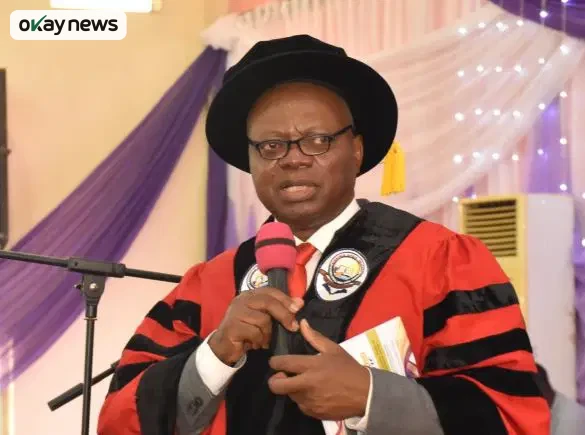
Former Vice Chancellor of the University of Ibadan, Professor Idowu Olayinka, has presented an extensive roadmap aimed at strengthening academic traditions and improving institutional performance across Nigeria’s university system.
Professor Olayinka made these submissions while delivering the Convocation Lecture at the 14th Convocation Ceremony of the Adekunle Ajasin University, held in Akungba Akoko, Ondo State. His lecture was titled “Strengthening the Academic Tradition in the Nigerian University System.”
Okay News reports that the former Vice Chancellor identified the defining features of universities that are fully compliant with twenty-first century global standards. According to him, such institutions are distinguished by high-quality human resources, sustainable and adequate funding, strong physical and digital infrastructure, visionary and innovative leadership, robust pedagogical systems, intellectual property development frameworks, and deliberate internationalisation strategies.
He further listed additional requirements for a thriving university system, including a stable academic calendar, a transparent and merit-based admission process, and the availability of affordable, decent accommodation for students both within and outside campus environments.
Professor Olayinka urged both public and private stakeholders in Nigeria’s education sector to significantly scale up investment in higher education, warning that failure to do so would worsen the country’s educational deficit. He cautioned that Nigerian students would continue to seek university education abroad if local institutions fail to expand their capacity to admit qualified candidates.
According to him, “Nigeria’s population is expected to grow by approximately 130 million people by 2050, potentially reaching over 400 million and becoming the world’s third most populous nation, surpassed only by India and China. Moreover, the country has a predominantly young population, with around 43 percent of its citizens under the age of 15 in 2025. As this large youth cohort reaches university age, the number of potential candidates will surge.”
He stressed the importance of balancing wider access to university education with the rising costs and quality requirements of running higher institutions, noting that a university degree remains a critical pathway to improved employment prospects and social mobility in Nigeria.
The academic further identified persistent challenges undermining the university system, including inadequate funding, frequent strikes by staff unions, inefficient service delivery, ageing academic workforce, deteriorating teaching and research equipment, insufficient staff development, low morale, rising operational costs, and a disconnect between university training and labour market demands.
Addressing the impact of strikes by the Academic Staff Union of Universities, Professor Olayinka lamented the poor remuneration of Nigerian academics, describing their wages as among the lowest across Africa. He warned that this discourages talented professionals from pursuing long-term careers in academia.
He stated, “A nation that impoverishes its teachers undermines its future. Nigeria must learn that intellectual labour cannot be chained, and scholars cannot be caged. Lecturers are global citizens who belong to a borderless world of thought, and a government that fails to honour them is, ultimately, dishonouring itself.”
To address staffing gaps, he advocated transparent and competitive recruitment processes to improve staff-to-student ratios across departments. He also called for more rigorous staff development programmes, including consistent participation in seminars, conferences, and workshops to support academic career progression.
“All teaching staff should continue to be encouraged to take advantage of the ICT facilities in the university, especially in teaching and supervising postgraduate students,” he said.
He further recommended that postgraduate supervision should continue for up to three years after a supervisor’s retirement under special arrangements, and that emeritus professors and adjunct academics should be better integrated into postgraduate teaching and supervision.
Professor Olayinka also stressed the importance of maintaining existing teaching and research infrastructure, alongside continuous investment in modern equipment to enhance academic productivity.
He highlighted the need for a balanced mix of early-career academics such as Senior Lecturers and experienced scholars including Readers and Professors to ensure smooth departmental transitions and sustainable academic growth.
In his remarks, the Vice Chancellor of Adekunle Ajasin University and Chairman of the occasion, Professor Olugbenga Ige, described the Convocation Lecture as a platform for engaging transformative ideas capable of shaping the future of universities in an evolving society.
Professor Ige commended Professor Olayinka for his lifelong commitment to academic excellence, describing him as a consummate scholar and visionary administrator who consistently upholds university traditions.