

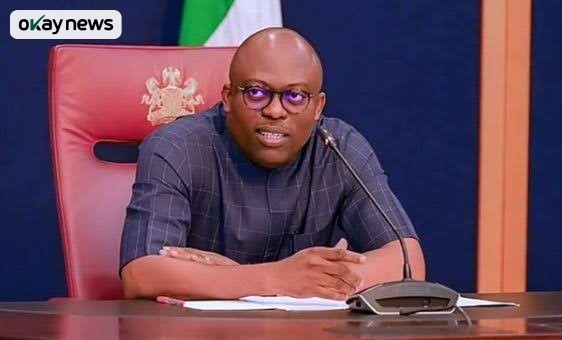
The Governor of Rivers State, Siminalayi Fubara, has openly acknowledged that prolonged political instability significantly slowed governance during the first twenty-three months of his administration, but assured residents that his government has now regained focus and capacity to deliver visible development across the state.
Governor Fubara made the disclosure on Saturday, 20 December 2025, while speaking in Bonny Local Government Area, Rivers State, southern Nigeria, during a formal reception organised in his honour by King Edward Asimini William Dappa Pepple III, the Amanyanabo and Natural Ruler of the Bonny Kingdom, alongside the Grand Bonny Chiefs Council. Okay News reports that the event formed part of activities marking the Iria ceremony of Her Royal Highness, Queen Paula Tamunoipirinye Pepple, wife of the monarch.
The Iria ceremony, a culturally significant rite within the Bonny Kingdom, took place at Ikuba Square, Bonny Island, and drew traditional rulers, chiefs, community leaders, and stakeholders from across the ancient coastal kingdom.
While addressing the monarch and council of chiefs at the royal palace, Governor Fubara described his administration’s first twenty-three months as deeply challenging, citing political instability and institutional resistance as major constraints to effective governance delivery.
“Twenty-three months of my administration has been wahala. The instruments meant to deliver good governance are the same ones making things difficult. It has never been our intention to deny our people the true feel of government,” the governor said.
Despite the setbacks, Fubara stated that his administration still recorded measurable progress in strategic sectors, particularly education and infrastructure. He noted that inherited projects in Bonny had begun yielding positive outcomes and would be expanded in line with the state’s broader development agenda.
The governor emphasized the strategic importance of Bonny as a global economic hub, home to major multinational energy operations, including the Nigeria Liquefied Natural Gas Limited (NLNG), one of Africa’s largest natural gas processing facilities.
“Bonny has expanded. It needs internal roads, shore protection and more economic activities. NLNG is here, and government must also be here,” he said.
Governor Fubara announced concrete plans to construct new internal road networks, implement shoreline protection projects to combat coastal erosion, and roll out initiatives aimed at stimulating local economic activity. He assured residents that tangible government presence would be felt in the area soon.
“Before the end of the first quarter of 2026, you will see and feel the presence of the Rivers State Government in Bonny,” he pledged.
The governor also expressed gratitude to King Edward Pepple III for his patience and steadfast support during what he described as the most difficult period of his administration.
“Our relationship is not based on benefits but on sincerity and mutual respect. No matter what happens, I will continue to stand with you,” he said.
During the ceremony, Fubara accepted a prestigious traditional title, Amaopu Senibo of Grand Bonny, describing the honour as a call to greater responsibility and service to both Bonny Kingdom and Rivers State.
“Chieftaincy is a sign of responsibility. It is a call to duty to Bonny and Rivers State, and I will not let you down,” he pledged.
In his remarks, King Edward Pepple III explained that the reception was organised to maximise the governor’s presence in Bonny during the Iria ceremony, urging him to personally follow up on issues raised by the council of chiefs.
“This is not a normal session, and we expect follow-up,” the monarch said.
The Chairman of the Bonny Chiefs Council, Se-Alabo Dagogo Soala Wilcox, a retired Lieutenant Colonel, commended the governor for appointing Bonny indigenes into key positions within his administration, while outlining areas requiring urgent state intervention to strengthen residents’ sense of inclusion.