Nigeria’s downstream petroleum market is undergoing a turbulent but necessary transformation that will ultimately favour consumers, according to the leadership of the Nigerian National Petroleum Company Limited, the state-owned energy company responsible for Nigeria’s commercial oil and gas operations.
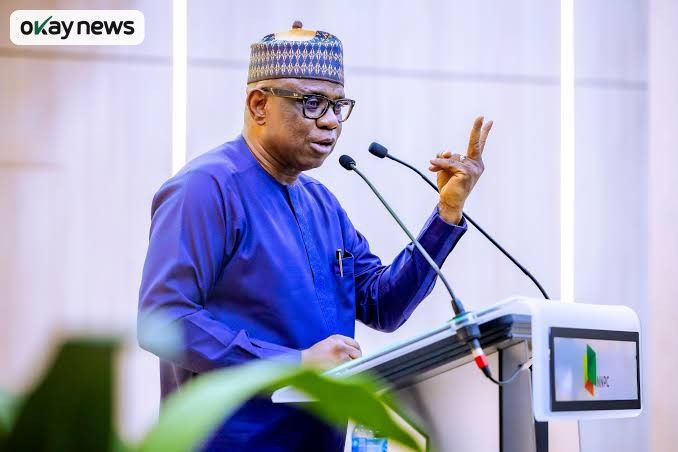
The Group Chief Executive Officer of the Nigerian National Petroleum Company Limited, Bayo Ojulari, gave the assurance on Sunday after briefing Nigeria’s President, Bola Ahmed Tinubu, in Lagos, Nigeria’s commercial capital. He said the current fuel price competition, widely described as a price war, is a natural outcome of Nigeria’s transition from fuel import dependence to domestic refining.
“Where there is healthy competition, the buyers are the ultimate beneficiaries. And I think for us, we need to keep our minds that the market will stabilise,” Ojulari told journalists.
He added, “After a while, there’ll be some tension, because we’re going through a major transition.”
Okay News reports that Ojulari’s remarks come amid intense rivalry among fuel suppliers, which has significantly reduced petrol prices across Nigeria. Premium Motor Spirit prices have fallen from over ₦1,200 per litre in November 2024 to as low as ₦739 per litre at select retail outlets in December 2025.
This sharp decline has been driven primarily by competition between the Dangote Refinery, owned by Aliko Dangote, Africa’s richest businessman and founder of the Dangote Group; the Nigerian National Petroleum Company Limited; and independent petroleum marketers operating across the country.
“At the end of the day, I can tell you that Nigerians on the street are going to be the beneficiaries,” Ojulari said.
Clarifying the role of the Nigerian National Petroleum Company Limited in the liberalised market, Ojulari explained that the Petroleum Industry Act, passed into law in 2021 and fully implemented in 2022, fundamentally restructured Nigeria’s oil and gas sector.
“The first thing you have to know is that the PIA did something fundamental. Before the PIA in 2021, which rolled in 2022, everything was under NNPC, including some regulations. The PIA divided the roles of regulation from what I will call the business,” he said.
He explained that downstream and midstream regulation now rests with the Nigerian Midstream and Downstream Petroleum Regulatory Authority, while upstream activities are regulated by the Nigerian Upstream Petroleum Regulatory Commission.
“So it’s very important that Nigerians understand that post-PIA, we as NNPC are not regulators,” Ojulari stressed.
According to him, the law repositioned the Nigerian National Petroleum Company Limited as a fully commercial entity required to operate profitably without reliance on government allocations.
“We have been instituted by the PIA to become a commercial company, which means a company that needs to compete profitably and be successful profitably,” he said.
Ojulari disclosed that the company no longer receives federation allocations and must now source financing independently like private sector enterprises.
Nigeria’s downstream petroleum market has been highly competitive since September 2024, when the Dangote Refinery, Africa’s largest single-train refinery with a production capacity of 650,000 barrels per day, began producing petrol locally.
Data from Nigeria’s National Bureau of Statistics shows that the average retail price of petrol declined by ₦153 per litre between November 2024 and November 2025, dropping from ₦1,214.17 to ₦1,061.35 due to improved supply and heightened competition.
The competition escalated further in December 2025 after Dangote Refinery slashed its ex-depot price from ₦970 to ₦699 per litre, triggering price cuts across the market. MRS filling stations, Dangote’s retail partner, began selling at ₦739 per litre nationwide, while Nigerian National Petroleum Company Limited retail outlets adjusted prices to between ₦825 and ₦840 per litre, depending on location.
Independent marketers followed suit, with some selling petrol for as low as ₦865 per litre, according to industry data.
Petroleumprice.ng reported that Dangote Refinery made more than 20 price adjustments in 2025 alone, reflecting the volatility of the evolving market.
However, the rapid reductions have placed pressure on marketers who bought fuel at higher prices and now face losses or dwindling patronage.
The Marketers Association of Nigeria confirmed that competition now dictates customer loyalty. Its spokesperson, Chinedu Ukadike, said, “Price competition now determines customer loyalty,” adding that “any marketer unwilling to adjust prices risks losing patronage and facing mounting bank interest costs.”
Ojulari described the Nigerian National Petroleum Company Limited as the “supplier of last resort,” noting that the company works closely with all major downstream players, including Dangote Refinery, in which it holds an equity interest.
“For us as NNPC, our focus is to generate more production. As we generate more production, we believe there’ll be more production to feed the refineries as much as possible,” he said.
He acknowledged that the simultaneous operation of major refineries has disrupted the market but insisted the development is positive for Nigeria and the wider West African region.
“To be honest with you, by the time you have a refinery like Dangote in-country, which has not been there before, with NNPC refinery now under a major relook, such a huge refinery in the country, you can expect the market will be impacted right now,” he said.
Beyond fuel pricing, Ojulari disclosed that Nigeria’s crude oil production has risen from 1.5 million barrels per day in 2024 to over 1.7 million barrels per day in 2025, with a target of 1.8 million barrels per day in 2026. He added that gas production has increased from 6.5 billion standard cubic feet to over 7 billion standard cubic feet daily.
He also confirmed the completion of the main line welding of the 614-kilometre Ajaokuta–Kaduna–Kano gas pipeline, including the River Niger crossing, with commissioning expected in early 2026 to support power generation and industrial growth in northern Nigeria.