
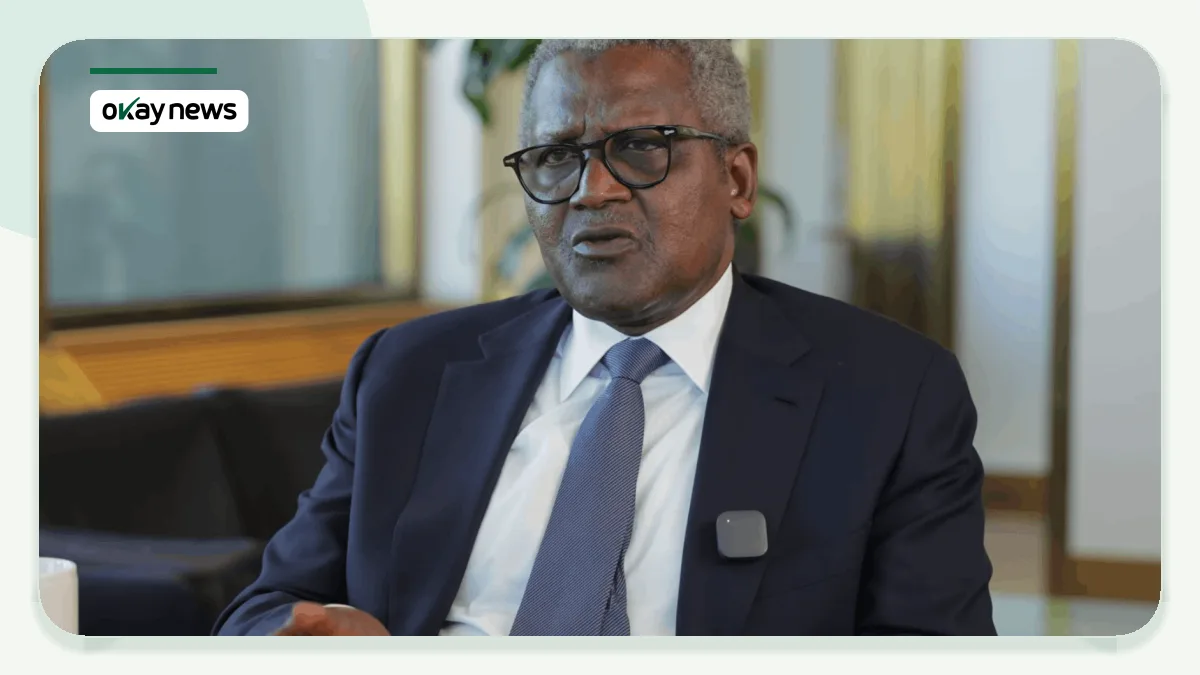
Africa’s richest businessman, Aliko Dangote, has said the Nigerian government earns more revenue from the Dangote cement business through taxes than the company itself makes in profit.
Dangote made the remark during an interview with Nicolai Tangen, chief executive officer of Norges Bank Investment Management, while discussing the relationship between governments and private sector investors in Africa.
According to him, governments across the continent are increasingly recognising that economic growth and job creation depend heavily on private sector participation.
“Government is making more money than us because of the various taxes that we pay,” Dangote said while speaking about the cement business operations of the Dangote Group.
The billionaire industrialist explained that governments benefit from value-added tax, corporate taxes and other levies generated from large-scale industrial activities, even in situations where companies are still investing heavily for growth.
Okay News reports that Dangote argued that African governments must create investor-friendly policies to encourage industrial expansion, infrastructure development and employment generation.
“But we’re happy because we’re also growing. So we’re okay with that,” he added.
Dangote said governments and private companies should operate as partners rather than adversaries, especially in developing economies where unemployment and infrastructure deficits remain major challenges.
“So it is a partnership where government will now give very good investment policies, good regulation and making sure that, yes, we also don’t abuse the system,” he said.
The founder of the Dangote Group also revealed that his company has invested billions of dollars in road infrastructure projects across Nigeria under tax credit arrangements approved by the government.
According to him, the arrangement allows companies to recover part of their infrastructure investments over a period of years through tax offsets.
Dangote stated that the private sector remains critical to Africa’s economic transformation because governments alone lack the financial resources required to create sufficient jobs for rapidly growing populations.
The businessman also used the interview to defend large-scale industrial investments in Nigeria, insisting that local production remains essential for Africa’s long-term economic independence.