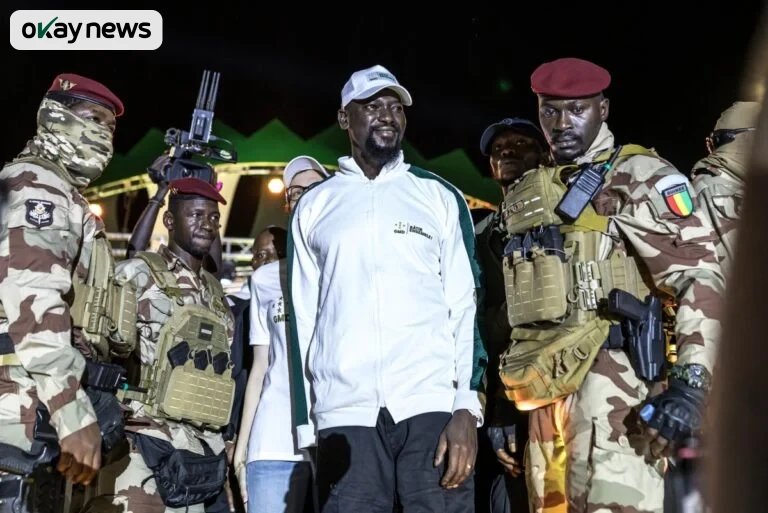
Guinea’s military ruler, Mamady Doumbouya, has been declared the winner of the country’s presidential election after securing an overwhelming majority of votes, according to provisional results released by the General Directorate of Elections, Guinea’s official electoral authority.
The announcement follows the presidential election held on Sunday, December 28, 2025, in Guinea, a West African country with significant mineral resources but widespread poverty. The vote marked a major political turning point for the nation, which has been under military-led transitional rule since a coup in September 2021.
According to figures presented by Djenabou Toure, head of the General Directorate of Elections, Doumbouya secured 86.72 per cent of the votes cast in the first round, a margin well above the threshold required to avoid a runoff election. Voter turnout was officially placed at 80.95 per cent nationwide.
Okay News reports that the 41-year-old army general contested the election against eight other candidates, although several prominent opposition leaders were excluded from the race under the country’s new constitutional framework. Many opposition groups had called for a boycott of the poll, arguing that the electoral process lacked credibility and inclusiveness.
Doumbouya, who assumed power after overthrowing Guinea’s first democratically elected president, Alpha Conde, had initially pledged not to seek elective office and promised to return the country to civilian rule by the end of 2024. His decision to run for president marked a reversal of that commitment and has remained a central point of controversy.
Partial results showed that Doumbouya dominated the vote in Conakry, Guinea’s capital city and largest urban centre, often securing more than 80 per cent of votes across several districts. Similar margins were recorded in Coyah, a town near Conakry, as well as in western regions such as Boffa and Fria, northwestern Gaoual, northern Koundara and Labe, and southeastern Nzerekore.
However, the credibility of the official figures has been questioned by civil society groups. The National Front for the Defence of the Constitution, a citizens’ movement advocating for a return to democratic governance, rejected the results outright.
“A huge majority of Guineans chose to boycott the electoral charade,” the group said in a statement issued on Monday.
Concerns were also raised by rival candidates. Presidential contender Abdoulaye Yero Balde alleged “serious irregularities,” accusing electoral authorities of denying his representatives access to vote-counting centres and pointing to reports of “ballot stuffing” in certain locations.
Another candidate, Faya Millimono, described the election as an exercise in “electoral banditry,” alleging that undue influence was exerted on voters during the process.
The election followed a constitutional referendum held in late September 2025, in which Guinean voters approved a new constitution that allowed members of the ruling junta to contest elections. The revised constitution also extended presidential terms from five years to seven years, renewable once.
Several leading opposition figures were barred from contesting under the new rules. Former Prime Minister Cellou Dalein Diallo was excluded on the grounds that he lives in exile and maintains his primary residence outside Guinea. Alpha Conde and another former prime minister, Sidya Toure, were disqualified for exceeding the constitutional age limit of 80 years.
Doumbouya’s presidency comes amid continued criticism of his administration’s record on civil liberties. Since seizing power, his government has banned public protests, restricted political freedoms, and seen opponents arrested, prosecuted, or forced into exile.
As Guinea enters a new political phase under an elected leader with military origins, questions remain over national reconciliation, democratic credibility, and the future of political freedoms in the country.