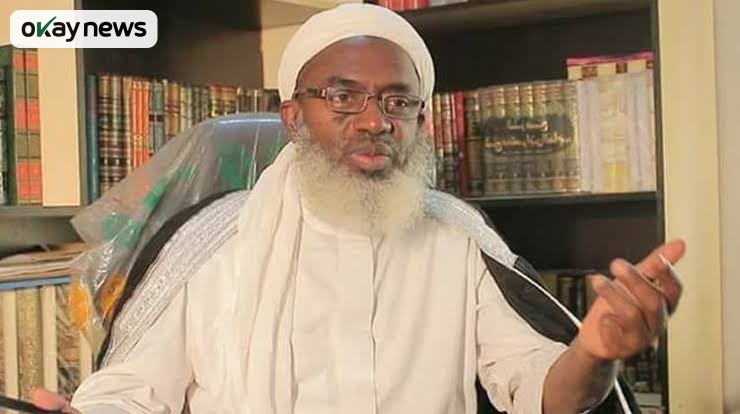
Islamic cleric Sheikh Ahmad Gumi has again stirred national debate by asserting that the kidnapping of schoolchildren, although unacceptable, represents a “lesser evil” when compared to the killing of military personnel. He made the statement during an interview granted to the British Broadcasting Corporation and made public on Tuesday.
Gumi explained that while the abduction of minors is unquestionably wrong, instances where the victims are later released without physical harm make the act comparatively less grievous than murder. According to him, “Saying that kidnapping children is a lesser evil than killing your soldiers, definitely is lesser. Killing is worse than, but they are all evil. It is just a lesser evil. Not all evils are of the same power.”
Okay News reports that the cleric referenced earlier mass abductions such as the one in Kebbi State, noting that the children were ultimately freed alive. He stated, “So it is a lesser evil than, like, what happened in Kebbi. They abducted children, and they were released. They did not kill them.”
His remarks come amid the ongoing abduction crisis in Niger State, where more than 315 persons, including three hundred and three students and twelve teachers, were seized by armed groups. The Federal Government confirmed on 7 December that one hundred students had been released, while fifty others reportedly escaped shortly after the attack.
When asked during the interview what message he had for the parents of the students still in captivity, the cleric replied, “It is an evil, and we pray that they escape.”
Gumi maintained that Nigeria must accept negotiation as a central strategy in addressing insecurity, insisting that dialogue with non-state actors is widely practiced, even if publicly denied. “That word ‘we do not negotiate’, I do not know where they got it from. It is not in the Bible. It is not in the Quran,” he said. “In fact, it is not even in practice. Everybody is negotiating with outlaws, non-state actors, everybody. So who got it, and where did they get that knowledge from? We negotiate for peace and our strategic interests. If negotiation will bring stoppage to bloodshed, we will do it.”
The cleric stressed that previous engagements he had with bandit groups were conducted openly and with government involvement. “I go there with the authorities. I do not go there alone. And I go there with the press,” he said.
He added that his last meeting with armed groups took place in 2021, explaining that he had tried to bring multiple factions together, but the government at the time “was not keen” on the initiative. He said that his involvement ceased once the groups were formally designated as terrorists.
Reflecting more broadly on Nigeria’s security architecture, Gumi argued that the Nigerian Armed Forces cannot independently resolve the crisis. “We need a robust army… but even the military is saying our role in this civil unrest, in this criminality, is ninety-five percent kinetic. The rest is the government, the politics, and the locals. The military cannot do everything,” he stated.
The cleric emphasized that most bandits are rural Fulani herdsmen, not urban Fulani communities. He argued that many of them perceive themselves as fighting for survival because their cultural and economic identity is tied to cattle. “They are fighting an existential war… Their life revolves around cattle. In fact, they inherit them. They will tell you, ‘This cow I inherited from my grandfather.’ They are mostly Fulani herdsmen, not the Fulani town, because you have to differentiate between the two.”
His comments have again drawn attention to the complex, deeply rooted factors driving insecurity in the northwest, where mass kidnappings, raids, and conflicts continue to destabilize communities.