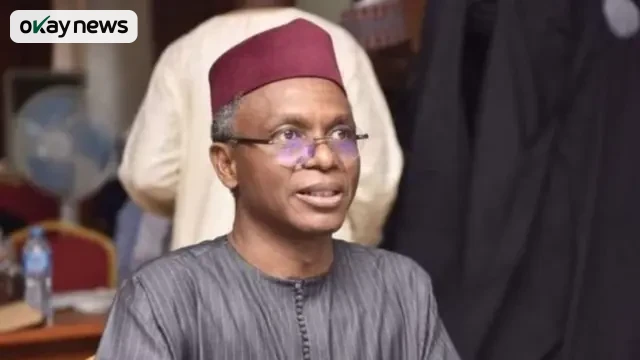
The Independent Corrupt Practices and Other Related Offences Commission, Nigeria’s federal anti-corruption agency known as the ICPC, has confirmed that it is holding former Kaduna State Governor Nasir Ahmad el-Rufai in connection with ongoing investigations.
Okay News reports that the development follows a series of high-profile encounters between the former governor and multiple Nigerian security and anti-graft agencies over the past week.
In a statement issued late on Wednesday, February 18, 2026, the Commission’s spokesperson, J. Okor Odey, who heads the ICPC’s Media and Public Communications Unit, confirmed that el-Rufai was in the agency’s custody as of the close of work that day.
“The Independent Corrupt Practices and Other Related Offences Commission (ICPC) writes to state that Malam Nasiru El-Rufai the former Governor of Kaduna state is in our custody as at close of work today Wednesday the 18th day of February, 2026. Malam Nasiru El-Rufai is in the custody of the Commission in connection with investigations,” the statement read.
The ICPC did not disclose the specific allegations under investigation.
El-Rufai previously served as Governor of Kaduna State, a northwestern state in Nigeria, from 2015 to 2023. He has recently faced scrutiny over allegations of financial misconduct during his time in office.
Earlier in the week, he had presented himself at the headquarters of the Economic and Financial Crimes Commission, Nigeria’s main anti-corruption agency known as the EFCC, following an invitation regarding alleged financial improprieties linked to his tenure.
The Department of State Services, Nigeria’s domestic intelligence agency often referred to as the DSS, had reportedly taken him into custody after he spent two nights at the EFCC headquarters. It remains unclear whether the DSS subsequently transferred him to the ICPC as part of the ongoing investigations.
In 2024, the Kaduna State House of Assembly, the legislative body of Kaduna State, indicted the former governor over the alleged diversion of ₦423 billion (about $282 million) in public funds, alongside accusations of money laundering. The Assembly called on relevant anti-corruption agencies to investigate the matter.
The case has also been marked by a series of dramatic claims and counterclaims. Last Thursday, security operatives reportedly attempted to arrest el-Rufai at Nnamdi Azikiwe International Airport in Abuja, Nigeria’s capital city, upon his arrival from Cairo, Egypt’s capital.
El-Rufai later alleged that the ICPC acted on the instruction of Nigeria’s National Security Adviser, Nuhu Ribadu, a senior government official responsible for national security coordination, by asking the Department of State Services to arrest him on arrival.
During a Saturday interview on Prime Time, a current affairs programme on Arise Television, a privately owned Nigerian broadcaster, el-Rufai claimed that “someone wiretapped” Ribadu’s phone, allowing him to listen to the National Security Adviser directing security operatives to effect his arrest.
On Monday, the Department of State Services filed a three-count charge against the former governor, accusing him of unlawfully intercepting the National Security Adviser’s telephone conversation.
The unfolding situation raises significant political and legal questions in Nigeria, particularly concerning accountability for public office holders and the relationship between security agencies and anti-corruption bodies. The ICPC has not yet indicated when or whether formal charges will be filed in connection with its own investigations.