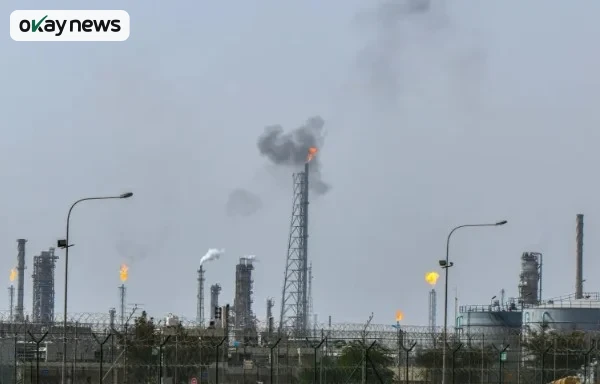
Kuwait City, Kuwait – Firefighters worked to contain a large blaze at the Mina Al-Ahmadi oil refinery in Kuwait on Friday, March 20, 2026, after the facility was struck by drones launched from Iran, in what marks a further escalation of hostilities across the Gulf region.
Okay News reports that the attack came amid a widening conflict involving Iran and Israel, with several countries in the Middle East increasingly affected. The refinery fire followed a separate strike a day earlier on Qatar’s Ras Laffan industrial complex, one of the world’s most important natural gas facilities.
Iran has intensified its military actions after an Israeli strike on Wednesday, March 18, 2026, damaged the South Pars gas field in southern Iran. That field is critical to Iran’s domestic energy supply and is part of the largest known natural gas reserve globally.
Despite international appeals, including calls from European leaders on Thursday, March 19, 2026, to avoid targeting energy infrastructure, the attacks have continued. The growing damage to key oil and gas facilities has triggered renewed concerns about global energy supply and rising prices.
Israeli Prime Minister Benjamin Netanyahu said during a press conference on Thursday that his country was gaining the upper hand in the conflict. “We are winning and Iran is being decimated,” he said, adding, “This war is ending a lot faster than people think.”
However, Iran has maintained that its military capabilities remain intact. A spokesperson for Iran’s Islamic Revolutionary Guard Corps stated, “Our missile industry deserves a perfect score… and there is no concern in this regard, because even under wartime conditions we continue missile production.” Shortly after the statement was published by Iranian media, reports emerged that the spokesperson had been killed in joint United States and Israeli strikes.
The conflict has also spread across the region. Missiles were reportedly fired toward Israel overnight and into Friday morning, with explosions heard in Jerusalem, though no casualties were confirmed. The United Arab Emirates reported similar attacks, while Saudi Arabia said it intercepted more than a dozen drones early Friday.
These developments came as Muslim communities across the region began observing Eid al-Fitr, the holiday marking the end of Ramadan, under the shadow of ongoing violence.
Energy experts have warned that the sustained targeting of oil and gas infrastructure could have long-term consequences for the global economy. Damage to Qatar’s Ras Laffan facility alone could cost an estimated $20 billion in annual revenue losses and may take up to five years to repair.
Analysts caution that prolonged disruption could lead to higher energy prices worldwide, increased inflation, and reduced consumer spending. Oil prices showed volatility on Friday, with Brent crude trading around $108 per barrel and West Texas Intermediate near $94.
The conflict has also caused significant humanitarian impacts. In Lebanon, where fighting has intensified between Israeli forces and Hezbollah, the death toll has exceeded 1,000, according to the country’s health ministry. Many civilians have been displaced, adding to regional instability.
Residents across affected countries have expressed concern about the economic and social impact of the war. In Beirut, families reported scaling back Eid celebrations due to financial hardship and displacement.
Meanwhile, diplomatic efforts continue. France’s President Emmanuel Macron has proposed discussions among permanent members of the United Nations Security Council to secure navigation through the Strait of Hormuz, a critical shipping route for global oil and gas. However, such talks are expected to begin only after hostilities subside.
As the conflict continues, uncertainty remains over how long the fighting will last and what further impact it may have on global energy markets and regional stability.