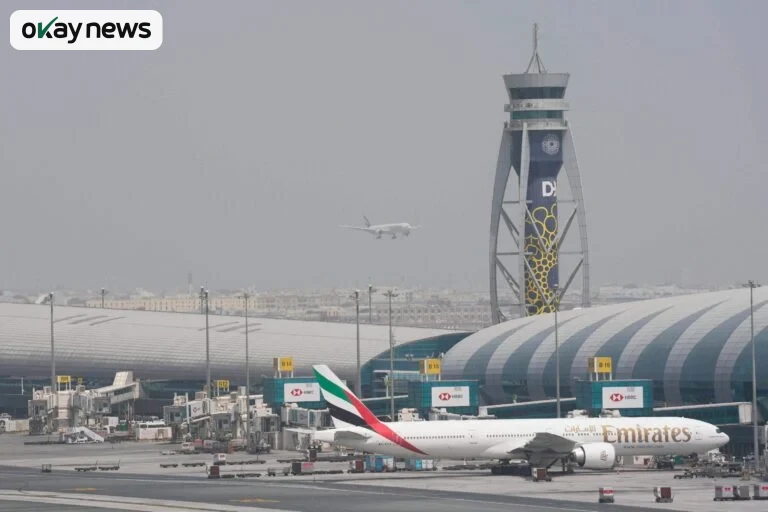
Dubai, United Arab Emirates — Drone attacks struck near Dubai International Airport in Dubai, the largest city in the United Arab Emirates, on Wednesday, March 11, 2026, leaving four people injured as regional tensions tied to the ongoing Middle East conflict continued to escalate.
Okay News reports that the latest incidents occurred as the Islamic Republic of Iran intensified its campaign of attacks across the oil-rich Gulf region, targeting maritime traffic, energy infrastructure, and locations linked to the United States.
The strikes follow recent United States and Israeli military operations against Iranian positions, which triggered a wider regional confrontation involving multiple countries in the Middle East.
According to security reports, drones landed close to Dubai International Airport, one of the world’s busiest aviation hubs for international travel. Emergency services responded quickly after the explosions, and authorities confirmed that four people sustained injuries.
The attacks were part of a broader pattern of disruptions affecting shipping routes and energy infrastructure across the Gulf.
The United Kingdom Maritime Trade Operations, the British military-linked organisation that monitors security threats to shipping in the region, said two commercial vessels were struck by unidentified projectiles near the coast of the United Arab Emirates.
One vessel was hit near Dubai, while another bulk carrier was struck close to Ras Al Khaimah, one of the northern emirates that make up the United Arab Emirates.
A third ship was also attacked in waters near the Sultanate of Oman, specifically in the Strait of Hormuz, the narrow maritime corridor between Oman and Iran that connects the Persian Gulf with the Arabian Sea.
The projectile strike on that vessel triggered a fire onboard. Maritime authorities later confirmed that the fire was successfully extinguished.
The Strait of Hormuz is considered one of the most strategically important shipping routes in the world. Nearly 20 percent of global oil supplies normally pass through the narrow waterway, making it critical to international energy markets.
Iran’s campaign has focused heavily on disrupting activity in the strait as part of what analysts describe as an effort to pressure global oil markets and international shipping operations.
Energy infrastructure across the region has also been targeted.
Authorities in the Kingdom of Saudi Arabia said their air defence systems intercepted drones aimed at the Shaybah oil field in eastern Saudi Arabia, a key facility for the country’s crude oil production.
Saudi officials also reported that seven ballistic missiles were intercepted as they headed toward the kingdom’s eastern region and Prince Sultan Air Base, a major military facility used by both Saudi Arabian and United States forces.
An American service member stationed at the base was killed during earlier attacks on Saturday, March 1, 2026.
Military and energy analysts say Tehran appears to be trying to shut down major oil refining facilities in the Gulf while tightening pressure on the Strait of Hormuz to cause maximum disruption to global energy supplies.
Recent attacks have targeted major oil installations, including the Ras Tanura facility operated by Saudi Aramco, the state-owned oil company of Saudi Arabia. Ras Tanura hosts one of the largest oil refineries in the Middle East.
Iranian forces have also targeted the Ruwais refinery in Abu Dhabi, the capital of the United Arab Emirates. The Ruwais complex is one of the largest refining and petrochemical facilities in the world.
The ongoing attacks are already affecting global energy production.
QatarEnergy, the state-owned energy company of the State of Qatar and one of the world’s largest producers of liquefied natural gas, announced last week that it had halted production and declared force majeure.
A force majeure declaration allows companies to suspend contractual obligations when extraordinary circumstances make normal operations impossible.
Energy producers in the State of Kuwait have made similar declarations, warning that the ongoing conflict could prevent them from meeting export commitments.
The continued attacks on shipping routes, airports, and energy infrastructure highlight the growing economic consequences of the Middle East conflict, particularly for global oil supply chains and international transportation.