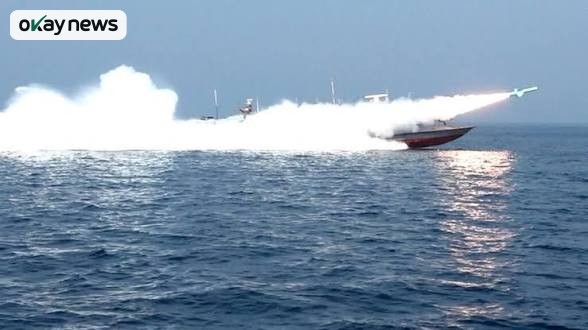
TEHRAN, Iran — The government of Iran threatened on Monday, March 23, 2026, to place naval mines in the Persian Gulf and attack power plants across the Middle East. This declaration comes as Iran rejects an ultimatum from United States President Donald Trump to reopen the Strait of Hormuz, a crucial global shipping route connecting the Persian Gulf to the Gulf of Oman. The United States gave Iran until 2344 Greenwich Mean Time (00:44 West Africa Time) to reopen the waterway or face the destruction of its power facilities. Despite the warning, Iranian authorities showed no signs of complying as the conflict entered its fourth week.
Okay News reports that Iranian officials instead threatened to release drifting explosive mines into the Gulf if their territory or islands are attacked. To emphasize their warning, Iran published maps highlighting major power plants in Israel, the Kingdom of Saudi Arabia, the United Arab Emirates, the State of Qatar, and the State of Kuwait as potential targets. An infographic circulated by local Iranian media featured the phrase, “Say goodbye to electricity!” It further stated, “In the event of the slightest attack on the electricity infrastructure of the Islamic republic, the entire region will be plunged into darkness.”
This escalation has triggered severe global economic anxiety. Fatih Birol, the head of the International Energy Agency (IEA), warned that the continuing conflict could create a global energy crisis worse than the oil shocks of the 1970s and the Russian invasion of Ukraine combined. More than 40 energy facilities in the region have already sustained heavy damage, pushing oil prices above $100 per barrel. Addressing the situation, Birol noted, “No country will be immune to the effects of this crisis if it continues.” The ripple effects are already being felt worldwide. The government of China has capped domestic fuel prices, the government of Greece has promised financial relief for its citizens, and a major energy supplier in the Kingdom of Cambodia has suspended the sale of liquefied petroleum gas.
Meanwhile, military strikes continue to claim lives and damage infrastructure. Early on Monday, March 23, 2026, Israel launched fresh airstrikes on Tehran, sending thick black smoke into the sky. Over the weekend, Iranian missiles successfully bypassed Israeli air defenses to strike two southern Israeli towns, including Dimona, a city near an Israeli nuclear facility. The strike injured dozens of people. Galit Amir, a 50-year-old local resident, described the shock of the attack, saying, “We thought we were safe.” As the fighting continues to involve neighboring countries like the Lebanese Republic, global leaders from the Russian Federation and China are urgently calling for diplomacy to prevent the conflict from spiraling further out of control.