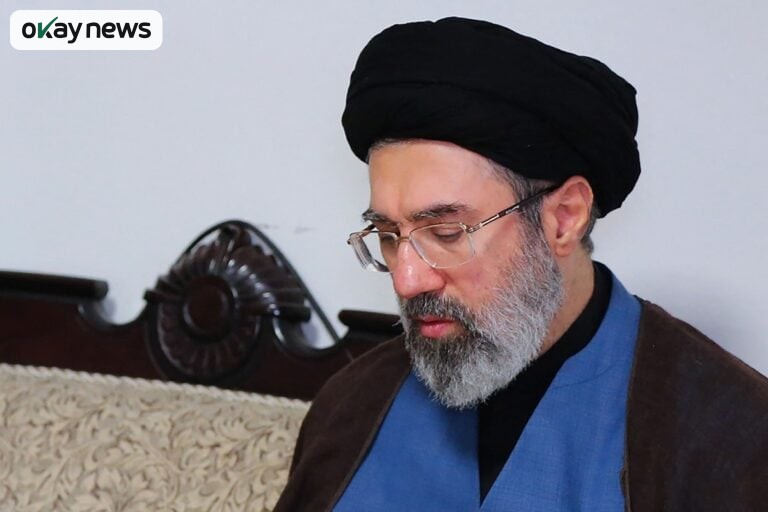
Tehran, Iran — Iran’s newly appointed supreme leader, Mojtaba Khamenei, has reportedly suffered injuries but remains alive and in stable condition, according to a statement from the son of Iran’s president.
The update came amid growing speculation about the whereabouts and health of Mojtaba Khamenei, who has not appeared publicly since he was appointed supreme leader over the weekend. Okay News reports that the 56-year-old cleric assumed the powerful position after the death of his father, Ali Khamenei, the long-serving Supreme Leader of the Islamic Republic of Iran, who was killed in an air strike during the early stage of the ongoing war involving Iran, the United States, and Israel.
The reassurance about the new leader’s condition was shared by Yousef Pezeshkian, a government adviser and the son of Iran’s President Masoud Pezeshkian. In a message posted on his Telegram channel, he addressed reports circulating about the new leader’s health.
“I heard news that Mr Mojtaba Khamenei had been injured. I have asked some friends who had connections,” Yousef Pezeshkian wrote.
“They told me that, thank God, he is safe and sound,” he added.
Mojtaba Khamenei had previously operated largely behind the scenes within Iran’s political and religious establishment. However, he was elevated to the country’s highest authority by the Assembly of Experts, a powerful clerical body responsible for selecting and supervising Iran’s supreme leader.
Despite the appointment, uncertainty has surrounded his situation because he has not been seen publicly since the announcement. State television described him earlier as a “wounded veteran of the Ramadan war,” referring to the conflict that erupted during the Islamic holy month of Ramadan, but officials did not provide detailed information about the injuries.
Reports from international media outlets have suggested that Khamenei may have been hurt during the air strike that struck a residential compound in Tehran on Friday, February 28, 2026. That attack reportedly killed his father, Ali Khamenei, as well as other members of the family including his mother and wife.
According to a report by The New York Times, citing unnamed Iranian officials, Mojtaba Khamenei “had suffered injuries, including to his legs, but that he was alert and sheltering at a highly secure location with limited communication.”
Images of the new leader have appeared prominently across Tehran in recent days. Large billboards display his portrait, including one symbolic image showing him receiving Iran’s national flag from his father while Ruhollah Khomeini, the founding leader of the Islamic Republic of Iran after the 1979 Iranian Revolution, looks on.
Supporters of the Iranian government have also publicly rallied behind him. Thousands gathered in central Tehran on Monday, March 9, 2026, carrying posters of the new supreme leader during a pro-government demonstration.
However, opposition to his leadership has also surfaced in the capital. Reports from Tehran indicate that some residents have shouted slogans against him at night, including chants of “Death to Mojtaba!” reflecting deep divisions inside the country.
The position of supreme leader in Iran is the most powerful office in the Islamic Republic. The leader serves as the country’s highest political and religious authority and acts as a spiritual guide for Shia Muslims. The role is held for life and includes command over the armed forces and significant influence over national policy.
Security analysts believe Mojtaba Khamenei could remain hidden for some time due to security concerns. The assassination of his father in the early phase of the conflict has made him a likely target for further attacks.
Emile Hokayem of the International Institute for Strategic Studies, a London-based research organisation that analyses global security and military affairs, said the new leader may avoid public appearances for the foreseeable future.
He said he expected the leader “to sit in a bunker somewhere for a very long time because he saw what happened to his father, his wife, his mother, who were all killed in the initial attack.”
“Killing him early is certainly an Israeli priority. If he survives, he becomes a totem, a testimony to the resilience of the system,” Hokayem said during an online discussion hosted by the institute.
Hokayem also suggested that day-to-day government functions could be delegated to senior officials, including Iran’s national security chief Ali Larijani and the speaker of the Iranian parliament, Mohammad Bagher Ghalibaf, who may oversee the country’s wartime operations.
Iran’s military leadership has publicly pledged loyalty to the new supreme leader. Both the Iranian Armed Forces and the Islamic Revolutionary Guard Corps (IRGC), the powerful military organisation that operates alongside the regular army, have declared their allegiance.
Iran’s regional allies have also expressed support. The Houthi movement in Yemen and the Lebanese armed group Hezbollah, both of which receive backing from Tehran, have pledged loyalty to the new leader.
Russia has also signaled political backing. Russian President Vladimir Putin promised what he described as “unwavering support” for Iran following the leadership change.
Meanwhile, the leadership transition has drawn strong reactions from the United States. Before the official appointment, former United States President Donald Trump warned that Mojtaba Khamenei would be unacceptable as Iran’s next supreme leader.
“He’s going to have to get approval from us,” Trump told ABC News on Sunday. “If he doesn’t get approval from us, he’s not going to last long.”
The evolving situation highlights the growing instability surrounding Iran’s leadership during the ongoing conflict in the Middle East and raises questions about how the country’s political system will function while its newly installed leader remains out of public view.