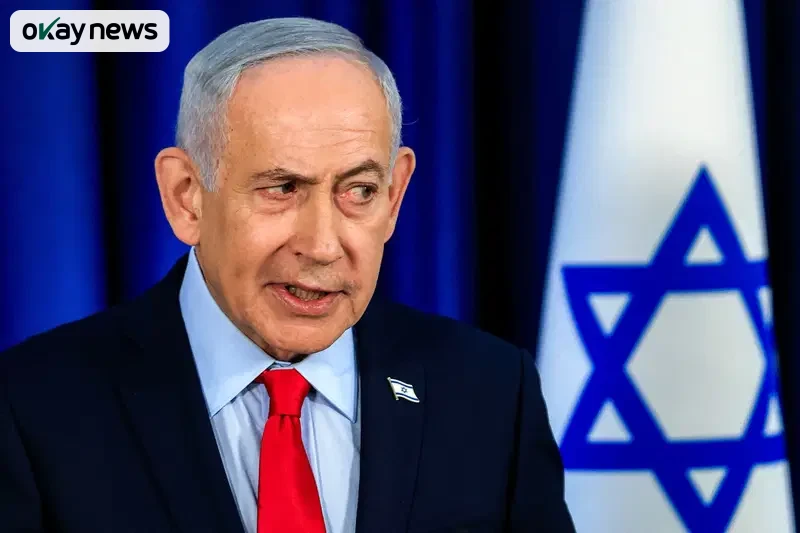
Jerusalem, Israel – Israeli Prime Minister Benjamin Netanyahu said on Thursday, March 19, 2026, that Iran’s military capabilities have been severely damaged, even as fresh attacks on key oil and gas facilities across the Gulf region rattled global energy markets.
The conflict, which began on Friday, February 28, 2026, involves Israel and the United States targeting Iran, raising fears of a prolonged war with global economic consequences. Speaking at a press conference in Jerusalem, Israel, Netanyahu declared that Iran’s strategic strength had significantly declined.
“We are winning and Iran is being decimated,” he said.
He added, “This war ending a lot faster than people think,” although he did not give a specific timeline.
Okay News reports that the Israeli leader also questioned the stability of Iran’s leadership, suggesting uncertainty at the highest levels of power in the country.
“I’m not sure who’s running Iran right now,” Netanyahu said.
“Mojtaba, the replacement ayatollah, has not shown his face,” he added, referring to the reported succession following the death of Iran’s Supreme Leader, Ayatollah Ali Khamenei, who was killed in an Israeli airstrike at the start of the war.
“We’re seeing cracks, and we’re trying to propagate them as fast as we can, not only in the top command. We’re seeing cracks in the field,” Netanyahu said.
While Israel and the United States expressed confidence in their military campaign, tensions escalated after Iran launched attacks on major energy infrastructure across the Gulf. These included strikes on the Ras Laffan liquefied natural gas facility in Qatar, as well as oil refineries in Saudi Arabia and Kuwait.
The attack on Ras Laffan followed an Israeli airstrike on Iran’s South Pars gas field on Wednesday, March 18, 2026. QatarEnergy said the damage to its facility was extensive and could result in annual losses of about $20 billion, with repairs expected to take up to five years.
In Saudi Arabia, a drone struck the Samref refinery in Yanbu, a port city on the Red Sea. Saudi authorities said they reserve the right to respond militarily. Meanwhile, in Kuwait, drone attacks triggered fires at the Mina Abdullah and Mina Al-Ahmadi refineries, which together process about 800,000 barrels of oil per day.
The conflict has also affected Israel directly. On Thursday, an oil refinery in the northern port city of Haifa was hit, with local media showing thick black smoke rising from the site.
The broader economic impact has been significant. Iran’s control over the Strait of Hormuz, a key global shipping route for oil, has added to market instability. Brent crude oil prices surged by 6 percent to $119 per barrel before easing to $110, while European gas prices jumped by nearly one-third.
In Lebanon, the violence has continued with heavy casualties. The Lebanese Ministry of Public Health reported that more than 1,000 people have been killed in Israeli airstrikes targeting southern and eastern regions of the country, as well as suburbs of the capital, Beirut.
Lebanese President Joseph Aoun, during a meeting with France’s Minister for Europe and Foreign Affairs, Jean-Noel Barrot, renewed calls for a ceasefire between Israel and Hezbollah, the Iran-backed armed group based in Lebanon, and urged the start of negotiations.
International concern has continued to grow. In Brussels, Belgium, leaders of the European Union called for a temporary halt to attacks on critical infrastructure such as energy and water facilities. The bloc also warned about the risk of large-scale migration into its 27 member countries due to the conflict.
United States President Donald Trump said there was no fixed deadline for ending the war but indicated that the United States remains aligned with Israel.
“We get along great. It’s coordinated, but on occasion, he’ll do something,” Trump said, referring to Netanyahu’s actions that Washington may not always support.
Trump also warned Iran against further escalation, saying the United States would “blow up” the South Pars facility if attacks on Gulf infrastructure continued. However, he noted that there are no current plans to deploy ground troops into Iran.
Iranian officials responded with strong warnings. The Khatam al-Anbiya Central Headquarters, which oversees Iran’s military operations, threatened the “complete destruction” of Gulf energy infrastructure if Israeli strikes continue. Iran’s Minister of Foreign Affairs, Abbas Araghchi, also said there would be “ZERO restraint” in response to future attacks.
Global powers, including the United Kingdom, France, Germany, Italy, Japan, and the Netherlands, pledged efforts to ensure safe navigation through the Strait of Hormuz. However, some countries indicated that any coordinated action would depend on a ceasefire.
French President Emmanuel Macron described the situation as a “reckless escalation” and called for direct talks between the United States and Iran. The United Kingdom warned that continued attacks on critical infrastructure could deepen the crisis across the region.
India and China also raised concerns about disruptions to oil supplies, given the strategic importance of the Strait of Hormuz to global energy markets.
United States Secretary of Defense Pete Hegseth said the timeline for ending the conflict remains uncertain but insisted progress is being made.
“It will be at the president’s choosing, ultimately, where we say, ‘Hey, we’ve achieved what we need to,’” he said.
As the conflict continues with no ceasefire in sight, concerns are growing about further economic disruption and the risk of a wider regional war.