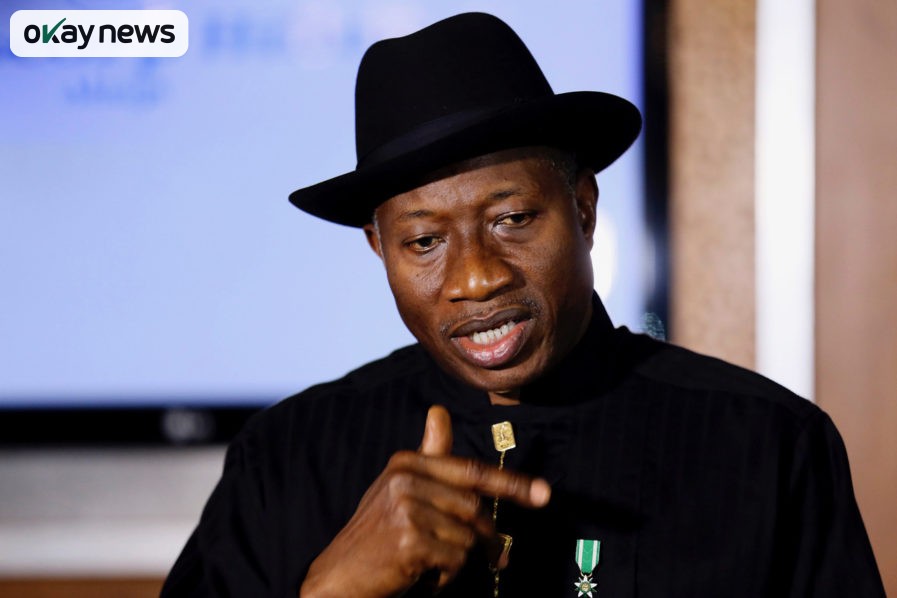
Goodluck Ebele Jonathan, a former President of Nigeria who served from 2010 to 2015, has urged countries across Africa to deliberately promote a new generation of leaders between the ages of 25 and 50, arguing that younger leaders are often better prepared for the physical and mental demands of governing in the modern era.
Jonathan spoke on Thursday, February 12, 2026, in Abuja, Nigeria’s capital, at the International Memorial Lecture and Leadership Conference held to mark 50 years since the assassination of General Murtala Ramat Muhammed, a Nigerian military head of state known for his brief but influential rule in the 1970s.
Reflecting on what high office requires, Jonathan said the pressures of government can be extreme, recalling the sleep deprivation he experienced while in office. “Why do we begin to think that you must be a hundred years old before you can rule your country?” he asked.
He argued that leadership demands stamina and resilience, and said younger leaders are more likely to cope with long, demanding schedules. “If they need to stay awake for 24 hours, they can stay awake for 24 hours. When I was in office, some days I did not sleep up to two hours. If you subject an older person to that kind of stress, the person will spend 50 per cent of the time in hospital,” he said.
Jonathan linked his comments to Nigeria’s “Not Too Young To Run” movement, a civic campaign that helped drive legal reforms to reduce age barriers for elected office and encourage wider youth participation in politics. Okay News reports that Jonathan used the moment to argue that Africa’s leadership pipeline should be intentionally widened to include younger candidates, not as a symbolic gesture but as a practical response to the realities of governance. “I have to reinforce the Not Too Young To Run movement. We have to bring some of these age limits down. If we are looking for people who can run nations in Africa, we should look within the 25 to 50 age bracket. That is when you can be very vibrant, physically strong and mentally sound,” he said.
He also criticised what he described as a pattern of some public officials spending extended periods away from their states or even outside their countries, warning that it can weaken oversight and create room for worsening insecurity. Jonathan contrasted this with practices he said are common in the United States, where some state governors remain largely within their states during their term, and asked how effective administration can continue when leaders are frequently absent.
Turning to history, Jonathan said the life and record of General Murtala Muhammed showed that age is not a barrier to decisive leadership. He noted that Muhammed became head of state at 38 and, despite leading for only 200 days, left behind a legacy that still shapes public memory of Nigerian leadership.
Jonathan also cited General Yakubu Gowon, another former Nigerian military head of state, who assumed office at 32 and later introduced the National Youth Service Corps (NYSC), a national programme that deploys young graduates for service and integration across Nigeria and remains active today. He pointed to Gowon’s role during the Nigerian Civil War as an example often cited by those who argue that younger leaders can carry heavy national responsibilities.
Still, Jonathan cautioned that youth alone is not enough. He said discipline, patriotism, and strong democratic institutions are essential, and he stressed that democratic governance works best when systems are stronger than personalities. “Democracy requires vision rather than decree. It requires persuasion instead of command. It depends on institutions, not individuals. Above all, it requires respect for the rule of law and the willingness to submit power to the will of the people,” he said.
He urged leaders to treat governance as stewardship rather than entitlement, and encouraged young people who want to enter politics to see leadership as service. He also recalled earlier political rules in Nigeria, saying that in the past, candidates had to meet higher age thresholds for key positions, even as the country honours leaders who took power at much younger ages.
As the conference marked Muhammed’s legacy, Jonathan said leadership should be judged by results, not by how long a person stays in office. He added that while military governments rule through command and authority, democratic leadership depends on credible institutions, election management bodies that can be trusted, an independent judiciary, well-trained security agencies, and accountability across government.