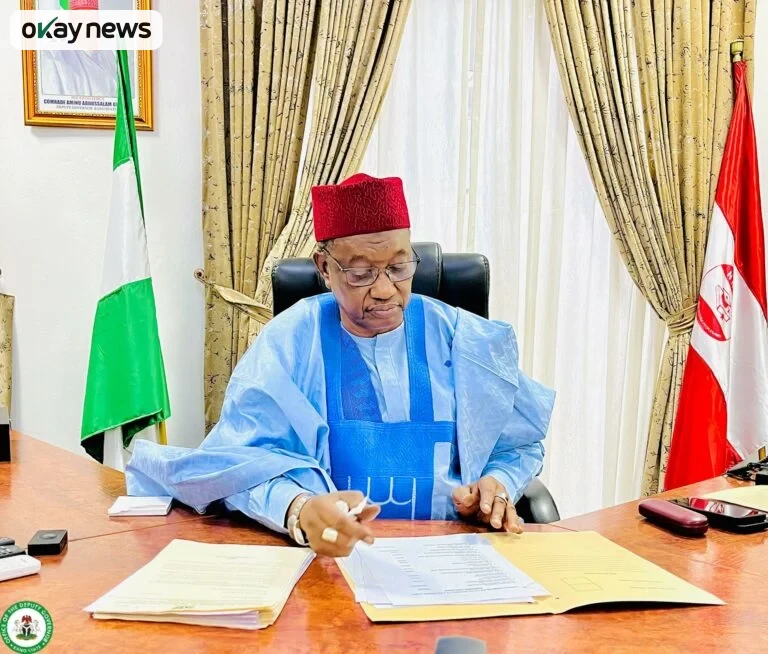
A senior official in Kano State, in northern Nigeria, has urged Deputy Governor Aminu Abdussalam Gwarzo to resign, arguing that it is difficult for an executive council to function smoothly when its top members no longer share the same political platform.
The Kano State Commissioner for Information and Internal Affairs, Ibrahim Waiya, made the call while speaking with journalists in Kano, the state capital, on Thursday, 29 January 2026, after the deputy governor chose not to move with Governor Abba Kabir Yusuf to a new political party.
Okay News reports that Waiya said governance at the highest level depends on trust, loyalty, and shared confidence among leaders who sit together to take key decisions. He argued that a deputy governor who is no longer politically aligned with the governor should not continue to participate in sensitive meetings where confidential government matters are discussed.
“This is his personal decision, but there is no way someone who is no longer with you should be part of the routine council meeting,” the commissioner said.
He added, “Who knows with whom he might share important government secrets? In government, things are done based on trust, and you cannot trust someone who is not with you.”
Waiya said resigning would be the most honourable path for the deputy governor under the circumstances, adding, “If I were him, I would humbly resign.”
The comments come amid shifting political alliances in Kano State following Governor Yusuf’s recent decision to leave the New Nigeria Peoples Party (NNPP) and join the All Progressives Congress (APC), Nigeria’s ruling party at the federal level.
Waiya described the governor’s switch as a move he believes could benefit Kano State, saying closer alignment with the Federal Government of Nigeria could improve the state’s access to national development projects and other forms of federal support.
Governor Yusuf, who won the 2023 Kano governorship election under the NNPP platform, said his decision to join the APC was driven by the need to strengthen cooperation with the Federal Government and attract more development projects to Kano State.
The governor’s defection ceremony in Kano also drew a wave of political figures who moved with him, including members of the Kano State House of Assembly, some federal lawmakers, as well as local government chairmen and councillors, a development that further reduced the NNPP’s influence in the state.
Kano State politics has long been highly competitive, and large-scale defections often reshape alliances ahead of future elections, especially when leaders seek stronger ties with Nigeria’s central government in Abuja, the country’s capital.