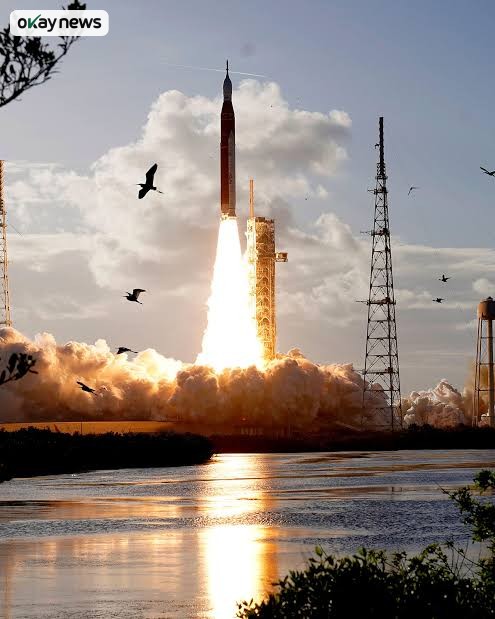
Kennedy Space Centre, Florida, USA – As NASA’s Artemis II mission progresses through its sixth day, the four-person crew is approaching their closest point to the Moon. This is roughly 4,070 miles from the lunar surface. Beyond the stunning images already beamed back, this flight is breaking long-standing records and laying the critical groundwork for the future of human space exploration.
Okay News understands that as the Orion spacecraft loops around the far side of the Moon today, April 6, 2026, the crew is testing deep-space capabilities while setting new benchmarks for humanity. Here are some of the most fascinating facts about the Artemis II mission and why it represents a monumental leap for the human race:
Shattering Apollo’s Distance Record
Later today, the Artemis II crew is expected to become the farthest humans ever to travel from Earth. They are projected to surpass the distance record set by the legendary Apollo 13 mission in 1970 (248,655 miles) by reaching a maximum distance of approximately 252,760 miles away from our home planet.
A Crew of Historic “Firsts”
This mission represents a new, inclusive era of space exploration, particularly since none of the four crew members were even alive during the last Moon landing (Apollo 17) in 1972. Mission Specialist Christina Koch is making history as the first woman to visit the Moon, while Pilot Victor Glover is the first black man to do so. Additionally, Jeremy Hansen of the Canadian Space Agency is the first non-American to ever travel beyond low-Earth orbit.
Extreme Speeds and Searing Heat
Upon returning to Earth on April 10, the Orion spacecraft will slam into the atmosphere at a staggering 25,000 mph (40,000 km/h), making the crew the fastest humans in half a century. The exterior of the capsule will endure extreme temperatures reaching 5,000°F (2,760°C)—roughly half the temperature of the sun’s surface.
Recycled Power and Massive Thrust
The Space Launch System (SLS) rocket that propelled them into space produces an earth-shaking 8.8 million pounds of thrust, making it 17% more powerful than the Saturn V rocket used during the Apollo era. Interestingly, to save costs and honor the past, the rocket’s core stage utilized four engines that previously powered 22 different Space Shuttle missions.
Life in a “Two-Minivan” Home
The crew is sharing a living space roughly the size of two minivans. Their 189-item menu—which includes beef brisket and chocolate pudding—is strictly crumb-free to prevent floating debris from damaging sensitive electronics. To combat muscle atrophy, they use a deep-space gym featuring a compact flywheel that provides up to 400 lbs (180 kg) of resistance. Also, unlike the International Space Station where urine is recycled into drinking water, the 10-day Artemis II mission simply flushes it directly into the vacuum of space.
Pioneering Deep-Space Science
Artemis II is heavily focused on scientific advancement. It is the first crewed mission to test optical (laser) communications, a system capable of transmitting high-definition video and data hundreds of times faster than traditional radio waves. The capsule is also carrying the “Organ-on-a-Chip” experiment, which uses human cells on microchips to study the real-time effects of deep-space radiation and microgravity on human health.
A Built-in “Safety U-Turn”
The mission is utilizing a “free-return trajectory.” This means that if the spacecraft’s engines were to completely fail right now, the Moon’s gravitational pull would act as a slingshot, automatically pulling the capsule back toward Earth without needing any further engine burns. However, this path also means the crew will experience a tense 40-minute total communication blackout with Earth as they pass behind the Moon.
Carrying everything from a piece of fabric from the Wright Brothers’ 1903 plane to a memory card holding millions of symbolic boarding passes submitted by the public, Artemis II is not just a test flight. It is a vital stepping stone toward establishing a permanent human presence on the Moon and, eventually, sending the first humans to Mars.