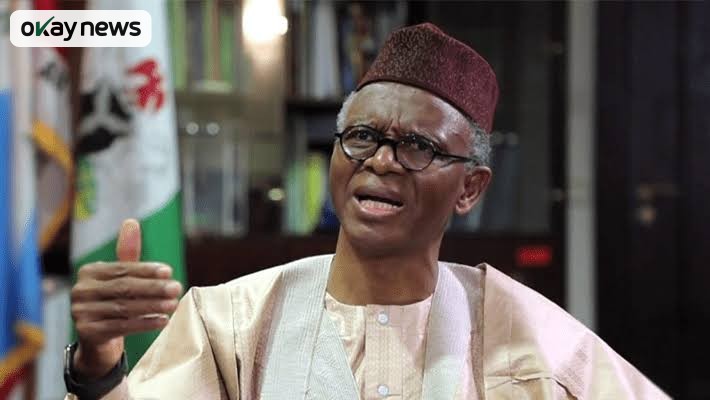
Abuja, Nigeria — The planned arraignment of former Kaduna State Governor, Nasir Ahmad El-Rufai, was stalled on Wednesday after Nigeria’s domestic intelligence agency, the Department of State Services (DSS), failed to produce him before the Federal High Court in Abuja, the capital city of Nigeria.
El-Rufai, who governed Kaduna State in northwestern Nigeria from 2015 to 2023, is facing a three-count charge filed by the DSS over the alleged unlawful interception of the telephone line of Nigeria’s National Security Adviser, Nuhu Ribadu. The National Security Adviser is the senior official responsible for coordinating national security matters for the President of the Federal Republic of Nigeria.
The DSS, which is responsible for internal security and intelligence operations, accused El-Rufai of breaching provisions of the Nigerian Communications Act 2003 by allegedly intercepting private phone communications without lawful authority.
When the case was called on Wednesday, prosecution counsel, Oluwole Aladeloye, a Senior Advocate of Nigeria, informed the court that the matter was scheduled for arraignment. However, proceedings could not go forward because the defendant was not present in court.
Aladeloye told the court that it was impossible to proceed in the absence of the defendant. He explained that El-Rufai could not be produced because he was currently in the custody of the Independent Corrupt Practices and Other Related Offences Commission (ICPC), Nigeria’s federal anti-corruption agency.
The prosecutor requested an adjournment to allow the DSS to liaise with the ICPC to ensure that the former governor is produced on the next hearing date.
Counsel to the defendant, Oluwole Iyamu, also a Senior Advocate of Nigeria, expressed dissatisfaction that his client was not brought before the court. Iyamu argued that if the DSS genuinely wanted El-Rufai in court, it would have been straightforward to secure his appearance since he was being held by another government agency.
He referred the court to Sections 158 and 159 of the Administration of Criminal Justice Act 2015, Nigeria’s principal federal law governing criminal procedure, and urged the judge to either hear his client’s pending bail application or order that he be produced in court the following day.
In her ruling, Justice Joyce Abdulmalik of the Federal High Court agreed with the prosecution that it would be premature to consider the bail application because the defendant had not yet been formally arraigned.
Justice Abdulmalik stated that it was the responsibility of the prosecution to produce the defendant before the court for arraignment. She subsequently adjourned the matter until Wednesday, April 23, 2026, for arraignment.
The delay adds another layer to a politically sensitive case involving two prominent figures in Nigeria’s security and political landscape. Okay News reports that the next court date will determine whether the arraignment can proceed and whether the former governor will formally enter a plea to the charges.