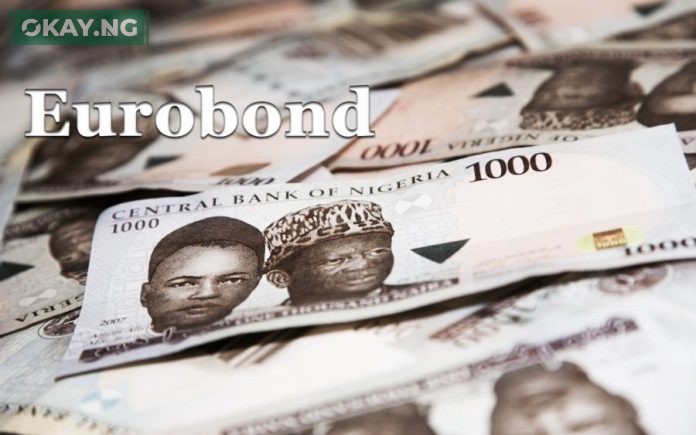
Nigeria Eurobonds have experienced a significant downturn, with yields surging to a 2024 high of 9.62%, as global markets reacted sharply to US President Donald Trump’s recently imposed sweeping tariffs. This marks a notable increase from the year’s opening yield of 9.50%, according to data released by Nigeria’s Debt Management Office (DMO). Simultaneously, the average price of the country’s sovereign bonds has dropped to $90.14 from $92.12, reflecting a broad sell-off across all maturities.
The market volatility stems from Trump’s executive order, which includes a substantial 14% tariff on Nigerian goods, triggering fears of an escalating global trade war. “The decision…marked a significant shift in U.S. trade policy, raising fears of a global trade war and disrupting business decisions,” as observed by market analysts, who witnessed stocks buckle under the weight of the announcement.
Adding to the market turbulence, US Treasury yields plummeted to a six-month low, as investors sought safe-haven assets amidst the uncertainty. This flight to safety underscores the profound impact of Trump’s reciprocal tariff policy on global financial stability.
However, amidst this volatility, J.P. Morgan has identified Nigeria’s Open Market Operation (OMO) bills as a “top trade recommendation” within frontier markets. The US-based bank cites Nigeria’s robustly improving foreign exchange (FX) reserves and the recent reforms at the Nigerian National Petroleum Company (NNPC) as pivotal drivers of investor confidence.
“Nigeria local markets remain our top trade recommendation within frontier markets,” J.P. Morgan stated in its latest emerging markets report, highlighting the relative insulation of frontier economies from global slowdowns and the attractive yields that offset potential currency risks.
The bank’s bullish stance is further supported by the Central Bank of Nigeria’s (CBN) disclosure of net FX reserves surging to $23.11 billion in 2024, a dramatic increase from $3.99 billion the previous year. This $19 billion boost, coupled with an $11.2 billion reduction in encumbered reserves, signals a move towards greater financial stability.
Read Also: JP Morgan Eyes Major Nigeria Expansion with Merchant Banking Bid
“This, in our view, is why the dollar/naira was under so much pressure last year and, going forward, should face less pressure as the central bank may ease off on the pace of net reserve accumulation,” the report explained.
Furthermore, J.P. Morgan lauded the overhaul of NNPC’s board and management as a crucial step in the nation’s oil sector reform agenda. While an immediate surge in oil production is not anticipated, the bank expects these reforms, alongside the Petroleum Industry Act and subsidy removal, to enhance transparency and improve government revenue streams.
The NNPC is also reportedly finalizing a medium-term FX financing arrangement, collateralized with future oil output, which could inject up to $9.5 billion into the economy. This potential influx of funds could be used to clear petrol import arrears and bolster FX reserves.
“The next catalyst is the new NNPC FX financing arrangements, which should boost FX liquidity in the near term,” J.P. Morgan noted.
However, the change in NNPC management has created some uncertainty regarding the timing of this financing arrangement.
In summary, while the Nigerian Eurobond market faces significant headwinds due to global trade tensions, J.P. Morgan’s endorsement of OMO bills highlights the underlying strength of Nigeria’s domestic financial reforms and improved FX reserves, offering a contrasting perspective on the nation’s economic outlook.