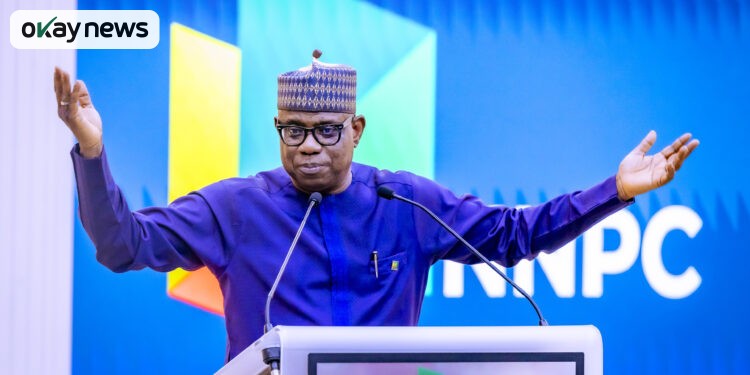
Houston, United States – Nigeria could increase its crude oil production by about 100,000 barrels per day over the next few months, according to Nigerian National Petroleum Company Limited Group Chief Executive Officer Bashir Bayo Ojulari, who spoke in an interview with Reuters on the sidelines of the CERAWeek by S&P Global energy conference in Houston.
Okay News reports that Ojulari said Nigeria is gradually building capacity to boost output, even if it cannot match the scale of top producers such as Saudi Arabia, stressing that the country can still make a meaningful contribution to global supply at a time when geopolitical tensions are affecting oil markets.
Ojulari explained that Nigeria averaged between 1.6 million and 1.7 million barrels per day of crude and condensates last year and is targeting an average of around 1.8 million barrels per day in 2026, saying the planned increase could help offset disruptions linked to conflicts involving the United States, Israel and Iran.
He noted that the Nigerian National Petroleum Company Limited has been implementing internal reforms, including a full portfolio review completed in 2025 and a renewed focus on project execution and delivery timelines, with efforts to ensure new projects are completed on budget after earlier delays.
These changes form part of broader attempts to improve the performance of Nigeria’s oil sector, where policymakers hope that greater operational efficiency will support incremental production growth and deliver more stable export and fiscal revenues.
Despite these efforts, Nigeria’s crude oil output remains under pressure, with production falling to about 1.31 million barrels per day in February 2026, down from roughly 1.46 million barrels per day in January, according to data from the Organisation of the Petroleum Exporting Countries.
Analysts say government income is closely tied to oil production volumes and international prices, so a sustained rise in output could help strengthen foreign exchange reserves and ease fiscal strain, particularly as Nigeria has set a more cautious 1.8 million barrels per day benchmark for its 2026 budget even though upstream regulators have talked about longer term ambitions of up to 2.6 million barrels per day of oil and condensates.
The Nigerian National Petroleum Company Limited is also pursuing plans to develop new oil fields from 2026 and has outlined a goal of attracting at least 30 billion dollars in investments by 2030, alongside a bid process to sell stakes in some oil and gas assets to optimise its portfolio with partners such as Shell, Chevron, Eni and TotalEnergies.
If the expected 100,000 barrel per day increase materialises in the coming months, it would signal early progress for Nigeria’s production recovery plans and could improve the country’s position within the wider OPEC alliance, where it has repeatedly struggled to meet its output quota in recent years.