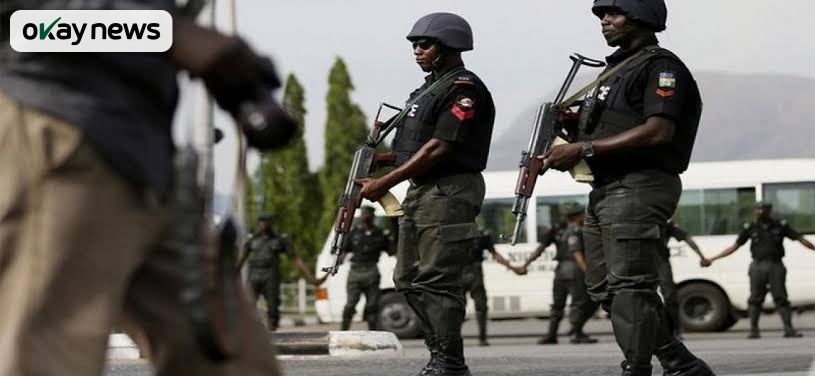
LAGOS, NIGERIA: The Nigeria Police Force has dismissed a human rights report claiming that armed groups abducted at least 1,100 people across the West African nation over a three month period.
The global advocacy group Amnesty International published the data, stating the kidnappings occurred between January and April of 2026. However, Nigerian law enforcement officials stated that the international organisation failed to verify the numbers with official security agencies before making the information public.
Anthony Placid, the Force Public Relations Officer for the Nigeria Police Force, questioned the validity of the claims during a media briefing on Monday, April 13, 2026.
“What is their source of information? They didn’t consult the police or cross-check with us. We have our records. And they didn’t check with us. If they didn’t consult us, then you should know better. Ask for the source of their report,” he said.
Okay News reports that Nigeria has battled prolonged security crises for over a decade. Armed groups, commonly referred to locally as bandits, and insurgent factions like Boko Haram carry out frequent attacks. This public disagreement between official government figures and reports from human rights observers highlights the ongoing struggle to accurately document the violence, which primarily targets rural villages and camps for internally displaced persons.
Amnesty International urged the Nigerian government to take immediate action against the rising insecurity. In a statement published on the social media platform X, the organisation directed its appeal to the nation’s leader.
“President Bola Tinubu and his government must urgently address the country’s horrifying spate of abductions targeting rural communities and internally displaced persons (IDPs) in the northern part of the country, as at least 1,100 people have been abducted in three months – from January to April 2026.”
Isa Sanusi, the Nigeria Director for Amnesty International, noted that the actual figures might be significantly higher than what is reported.
“Apart from killing people, gunmen are now on a rampage of abductions – largely for lucrative ransom. Some stay months at the mercy of gunmen in punishing situations. Estimates of the number of abductions by gunmen and armed groups across Nigeria vary, and some of the commonly cited figures vastly understate the scale of the problem,” said Sanusi.
The organisation detailed several large scale incidents to support its findings. In the northeastern state of Borno, Boko Haram fighters reportedly kidnapped more than 100 displaced persons near the town of Mafa in March. Another 400 people were taken from the Gwoza Local Government Area on Tuesday, March 3, 2026.
In the central region of the country, an attack on Woro village in Kwara State early in February resulted in the deaths of 200 people, with another 176 taken captive. The northwestern states of Zamfara and Kaduna also experienced major attacks, including a Sunday, January 18, 2026, raid on three churches in Kaduna State that resulted in 166 abductions, though reports indicate those individuals were later released.
The violence has left deep scars on surviving residents. A community member from Woro village in Kwara State shared their experience of the attack.
“They (attackers) didn’t just kill; they stole our life away. They abducted 176 people, including my second wife and my three daughters. One of them is only two years old. I have seen the video they posted on social media. I heard my wife’s voice. I saw my people. It has been almost two months now, and they are still in that forest.”
The human rights group warned that these kidnappings force families into extreme poverty. Relatives often sell their belongings or rely on community donations to pay ransoms. The constant threat has also disrupted local education systems, causing parents to withdraw their children from schools and forcing young girls into early marriages for perceived protection.
“In almost all cases of these abductions, people were also killed, homes and shops looted and razed. In some cases, families must dispose of everything they have to pay ransom, while villages often crowdsource to rescue their people. Those who could not pay are sometimes either killed, disappeared or tortured more. What we are witnessing right now in the northern part of Nigeria is a crisis of abduction that increasingly endangers lives,” Sanusi said.
In addition to the kidnappings, political figures are sounding the alarm over fatal attacks. Gbenga Olawepo-Hashim, a former Nigerian presidential candidate, stated that mass killings are being severely underreported and ignored by the international community.
He pointed to recent violence across multiple regions, estimating that between 130 and 300 people had been killed in a matter of weeks. Olawepo-Hashim criticised global institutions, including the United Nations (UN) and the African Union (AU), for their lack of response.
“What we are witnessing is a pattern of mass killings that fail to sustain national outrage or global attention,” Olawepo-Hashim said.
He added that the global silence sets a dangerous precedent for the nation.
“There is a growing perception that Nigerian lives have been so devalued that even routine expressions of condolence are no longer made,” he said.
Moving forward, civil society groups are calling for better collaboration with security agencies to document crimes accurately, while citizens await the fulfillment of President Bola Tinubu’s recent promises to support the Armed Forces in eradicating the violent factions.