


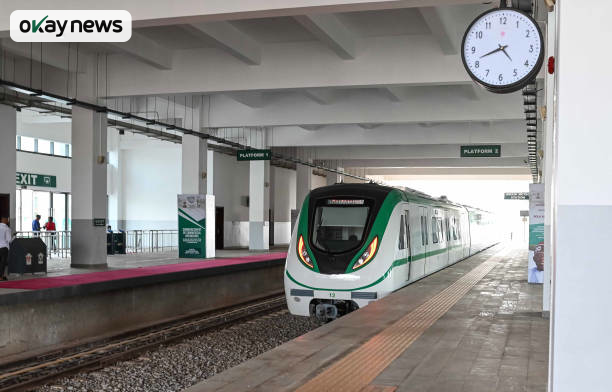
Abuja, Nigeria – Rail systems under the Nigerian Railway Corporation transported 3,888,661 passengers in 2025, generating N7.77 billion ($5.2 million USD) in passenger revenue. The figures were released by the National Bureau of Statistics in its annual rail transportation report.
Okay News reports that the data highlights the scale of Nigeria’s federally managed rail network and its contribution to national transportation infrastructure.
In the first quarter, 929,553 passengers generated N1.95 billion. This represented a 37.65% increase in ridership and 37.36% rise in revenue compared with the same period in 2024.
The second quarter saw 989,793 travellers earning N2.28 billion. This reflected 43.60% growth in passengers and 35.36% rise in revenue year-on-year.
In the third quarter, 1,028,839 passengers produced N1.94 billion. This continued the trend with 38.43% passenger growth and 14.44% revenue growth compared with 2024.
The final quarter recorded 940,476 passengers generating N1.60 billion. This marked a 9.32% decline in ridership and 16.30% fall in revenue compared with the fourth quarter of 2024.
While the first three quarters recorded robust performance, the final quarter’s slowdown moderated annual growth in passenger revenue.
Beyond passenger services, NRC-managed rail lines carried substantial cargo. Freight transport was strong in the first half, with 181,520 tons moved in the first quarter and 210,570 tons in the second. Cargo volumes declined in the third and fourth quarters to 130,540 tons and 110,480 tons respectively.
Freight revenue mirrored these trends. The corporation earned N657.03 million in the first quarter and N775.75 million in the second. This fell to N460.03 million and N397.82 million in the third and fourth quarters.
The Nigerian Railway Corporation operates long-distance passenger services on major corridors including Lagos-Ibadan, Abuja-Kaduna, and Warri-Itakpe.
The 2026 federal budget allocates N29.04 billion for railway modernization. This covers Abuja-Kaduna completion, Lagos-Ibadan upgrades, and Itakpe-Ajaokuta rehabilitation. An additional N102.3 billion is earmarked for the 68-kilometre Lagos Green Line linking Marina to the Lekki Free Zone.

 in passenger revenue. The figures were released by the National Bureau of Statistics in its annual rail transportation report.)