


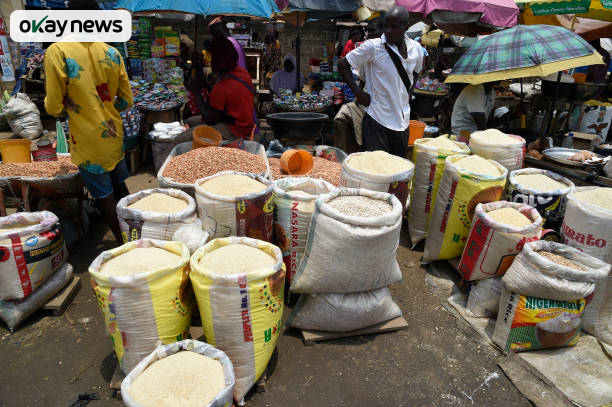
Abuja, Nigeria – Nigeria’s spending on food and beverage imports surged to N7.65 trillion ($5.1 billion USD) in 2025. The figures highlight the country’s increasing reliance on foreign food supplies amid rising domestic demand and structural challenges in the agricultural sector.
Okay News reports that the latest Foreign Trade Statistics report from the National Bureau of Statistics shows imports consist of both primary food products and processed items. These are used for industrial production as well as household consumption.
Primary food and beverage imports accounted for N3.49 trillion of the total. Of this amount, N2.09 trillion was imported mainly for industrial use, while N1.40 trillion was meant for household consumption.
Processed food and beverage imports reached N4.17 trillion, representing the largest share. Of the processed imports, N2.60 trillion was used mainly for industrial purposes such as food processing and manufacturing. N1.57 trillion was targeted at household consumption.
A substantial portion of Nigeria’s food imports is used as industrial inputs for food manufacturing. This underscores the role of imported raw materials in supporting the country’s food processing sector.
Nigeria’s food import expenditure has steadily increased over the past four years. In 2024, the country spent N6.58 trillion on food and beverage imports. In 2023, the bill stood at N3.83 trillion. In 2022, Nigeria recorded N2.86 trillion in imports.
The data indicate that Nigeria’s food import bill has more than doubled within four years. This raises concerns about long-term food security and dependence on imported supplies.
Nigeria could face a severe food crisis in 2026. Rising production costs, insecurity, and post-harvest losses are pushing many farmers, especially in the North-Central and North-West, to abandon agriculture.
The United Nations Food and Agriculture Organization has warned that about 34.7 million Nigerians could face severe food insecurity during the next lean season.

 in 2025. The figures highlight the country's increasing reliance on foreign food supplies amid rising domestic demand and structural challenges in the agricultural sector.)