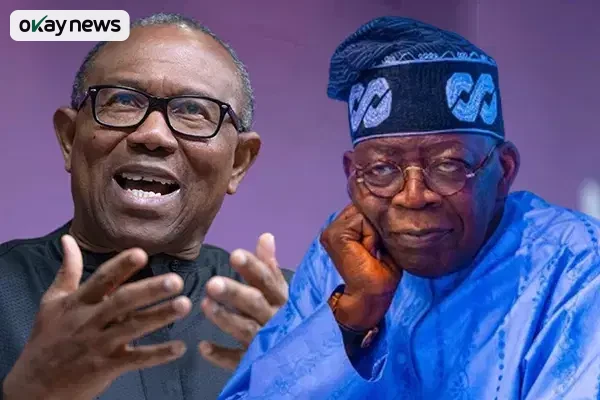
Abuja, Nigeria – Okay News reports that Dada Olusegun, Special Assistant to Nigeria’s President Bola Ahmed Tinubu on Social Media, has publicly challenged remarks made by Labour Party’s 2023 presidential candidate, Peter Obi, regarding the recent rise in fuel prices in Nigeria.
Olusegun made the comments in a post on the social media platform X on Saturday, addressing a statement Obi issued on Thursday. In his statement, Obi, the former governor of Anambra State in southeastern Nigeria, suggested that the nation’s susceptibility to global oil price fluctuations was due to the lack of a strategic petroleum reserve and poor governmental planning.
Obi linked the surge in fuel costs to tensions in the global oil market, particularly those involving Iran, which have influenced international crude oil prices. Petrol prices in Nigeria have reportedly climbed from below ₦1,000 (about $1.70) per litre to above ₦1,200 (about $2.05), while diesel rose from below ₦1,000 (about $1.70) to over ₦1,500 (about $2.55) per litre.
Responding to Obi, Olusegun rejected the assertion that the absence of a strategic reserve was the main reason for the price increases. He argued that the deregulation of Nigeria’s fuel market following the removal of subsidies was the key factor.
He said, “The recent rise in fuel prices in Nigeria is not primarily because the country lacks a strategic petroleum reserve. The more immediate factor is that the fuel market is now largely deregulated following the subsidy removal by the administration of Bola Ahmed Tinubu.”
Olusegun further explained, “In a deregulated system, petrol prices respond directly to global oil prices, exchange rates, shipping costs, and supply risks. So, when geopolitical tensions involving Iran push global oil prices upward, countries that rely heavily on imported refined products like Nigeria will inevitably feel the effect at the pump. That is simply how an open market behaves.”
He added that strategic petroleum reserves are generally not used to influence routine market prices. “Even countries with large strategic petroleum reserves, such as the United States and China, primarily deploy them only during emergencies such as wars, embargoes, or major supply chain disruptions,” he said.
Obi’s statement emphasized that many countries maintain petroleum reserves to cushion domestic markets against global oil shocks and to stabilize prices. He highlighted that Nigeria’s lack of such a buffer exposes the nation to immediate price impacts whenever global oil prices rise.
The debate is occurring amid wider concerns in Nigeria over the economic impact of rising fuel costs. Residents of the Federal Capital Territory (FCT) have reported rising transportation fares following the fuel price increase, which experts say may also drive broader inflationary pressures in the country.
Nigeria’s Midstream and Downstream Petroleum Regulatory Authority (NMDPRA) recently stated that fluctuations in fuel pump prices are directly linked to market forces under the country’s deregulated downstream petroleum sector.