
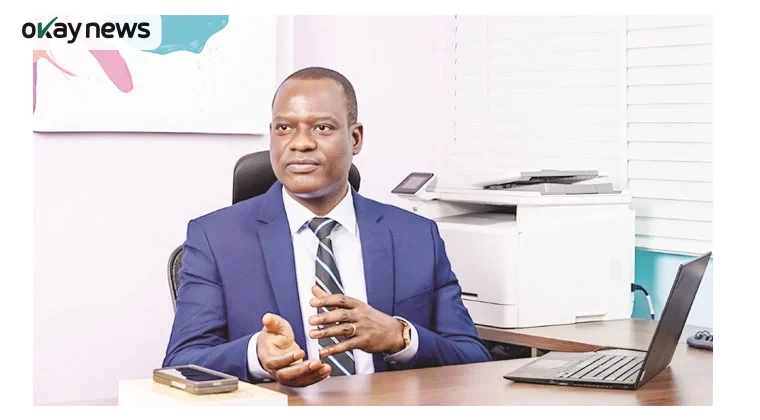
The Chairman of Nigeria’s Presidential Committee on Fiscal Policy and Tax Reforms, Mr Taiwo Oyedele, has assured citizens that the new tax laws scheduled to take effect on Thursday, 1 January 2026, will not permit the Federal Government of Nigeria to automatically deduct money from personal bank accounts.
Mr Oyedele, a Nigerian economist and tax expert appointed by President Bola Ahmed Tinubu to lead the national tax reform effort, explained that the reforms are based on a self-declaration system, rather than direct access to individual bank balances or transaction monitoring.
He gave the clarification while speaking on 2025 In Retrospect: Charting A Pathway To 2026, an end-of-year programme aired on Channels Television, a Lagos-based Nigerian private broadcaster with nationwide reach. Okay News reports that the appearance followed widespread public concern and misinformation surrounding the implementation of the new tax regime.
Addressing those fears, Oyedele rejected claims that the government plans to monitor or debit citizens’ bank accounts, stressing that individuals will only be required to declare their earnings at the end of each tax year.
“People think that the government will debit their bank accounts from next year, and how they even came up with that, I have no idea. Nobody will debit your account for any amount you transfer. Whether it is a billion or one thousand naira, at the end of the year, you tell the government yourself,” he said.
He further explained that the framework was intentionally designed to be transparent, simple, and fair, particularly for small business owners, informal sector workers, and individuals earning modest incomes across Nigeria’s diverse economy.
According to Oyedele, taxpayers are expected to distinguish between taxable income and non-taxable earnings and make honest declarations to the authorities.
“You know what constitutes your income and what does not. So you tell the government: ‘This is my income and here is the tax.’ If you are exempted, you simply declare: ‘This is my income, and I am exempted from tax.’ It is a very simple process that we are simplifying further,” he stated.
He added that one of the major outcomes of the reforms is the transition from a regressive tax structure to a progressive system, where low-income earners and small-scale entrepreneurs are no longer disproportionately burdened.
“One of the biggest benefits is that if you run a small business as a sole proprietor, an enterprise, or you are just hustling, the system will no longer be regressive, taxing the vulnerable more. We have made it progressive,” Oyedele said.
The clarification comes amid broader fiscal reforms championed by Nigeria’s President, Bola Ahmed Tinubu, whose administration has insisted that the new tax laws will proceed as scheduled.
The President recently described the reforms as “a once-in-a-generation opportunity to build a fair, competitive, and robust fiscal foundation” for Africa’s most populous country. He emphasized that the laws are not designed to increase tax burdens, but to restructure the system, harmonize existing frameworks, and strengthen trust between the government and citizens.
Tinubu also urged stakeholders, including businesses and civil society groups, to support the implementation phase, which he said has now entered what he described as “the delivery stage,” noting that no serious obstacle has emerged to justify halting the process.