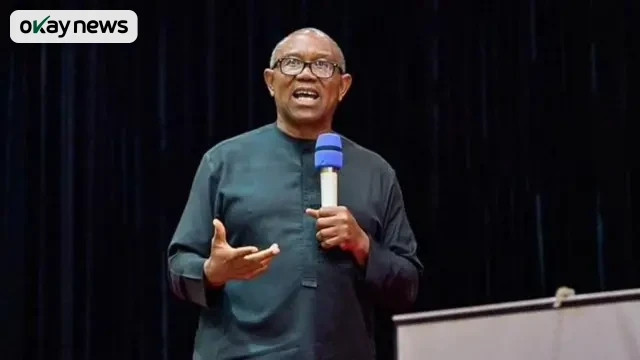
Achina, Anambra State, Nigeria — Former Anambra State Governor and 2023 presidential candidate of the Labour Party, Mr Peter Obi, has stated that no individual or group holds exclusive control over violence in Nigeria, while stressing that he has the constitutional right to visit any part of the country.
Obi made the remarks during a visit to Peter University in Achina, a town in Anambra State in southeastern Nigeria, where he addressed concerns following a recent incident in Benin City, the capital of Edo State in southern Nigeria. The episode had sparked tensions online, with some social media users warning him not to travel to certain areas of the country.
Speaking on the issue, Obi insisted that as a citizen of Nigeria, he is entitled to move freely across the country without intimidation.
“I am a Nigerian, and I am free to go to any part of this country. It is a constitutional right that nobody can take away from me. But let me make it clear, nobody has a monopoly of violence,” he said.
The former governor also explained why he proceeded with a planned visit to Rivers State in the Niger Delta region despite warnings from some individuals who urged him not to enter the state. According to him, he honoured the invitation shortly after the Benin incident and was not deterred by the threats circulating online.
Okay News reports that Obi has already declared his intention to run in Nigeria’s 2027 presidential election under the platform of the African Democratic Congress (ADC), a Nigerian political party. His decision followed his departure from the Labour Party, the political platform on which he contested the 2023 presidential election.
During his remarks, Obi alleged that there have been coordinated efforts aimed at preventing him from appearing on the ballot in the 2027 election. However, he said such attempts would not discourage him from pursuing his political ambition.
“I’m not desperate to be the President of Nigeria, but I’m desperate to see Nigeria work.
“Nigeria has collapsed and is already lying on the ground. Nigeria is not working because many rich Nigerians are greedy. They have everything they need, but are still scavenging for more.
“No matter what they do, I must contest the election. Let them declare a free and fair contest, bring the ball to the centre of the field and declare it started, and let us see what happens.
“With their 30 governors, they should make the election free and fair,” Obi said.
The politician also spoke about the broader social and economic conditions in Nigeria, a country of more than 220 million people and Africa’s largest economy. He argued that the current system favours wealthy elites while leaving many ordinary citizens with limited opportunities.
“We want a country where the son of a nobody can become somebody without knowing anybody,” he said.
Obi also addressed his decision to leave the Labour Party and join the African Democratic Congress. According to him, the move followed a prolonged leadership dispute within the Labour Party and disagreements involving Nigeria’s election management body.
He explained that the Labour Party had been engaged in court battles over its leadership, with some judgments issued in its favour. However, he alleged that the Independent National Electoral Commission (INEC), Nigeria’s national electoral body responsible for organising elections, did not initially recognise those rulings.
“You all know that I’m now in ADC. People have been asking why I left LP. We had been in court over the leadership of the Labour Party and secured favourable judgments, but INEC refused to recognise them.
“When I left on December 31, the same orders they were rejecting were suddenly recognized in January,” he said.
Obi further claimed that there are ongoing discussions about constitutional amendments that could potentially affect his political ambitions ahead of the next presidential election scheduled for 2027.
His comments come as political parties and prominent figures across Nigeria gradually begin positioning themselves for what is expected to be another highly competitive national election cycle.