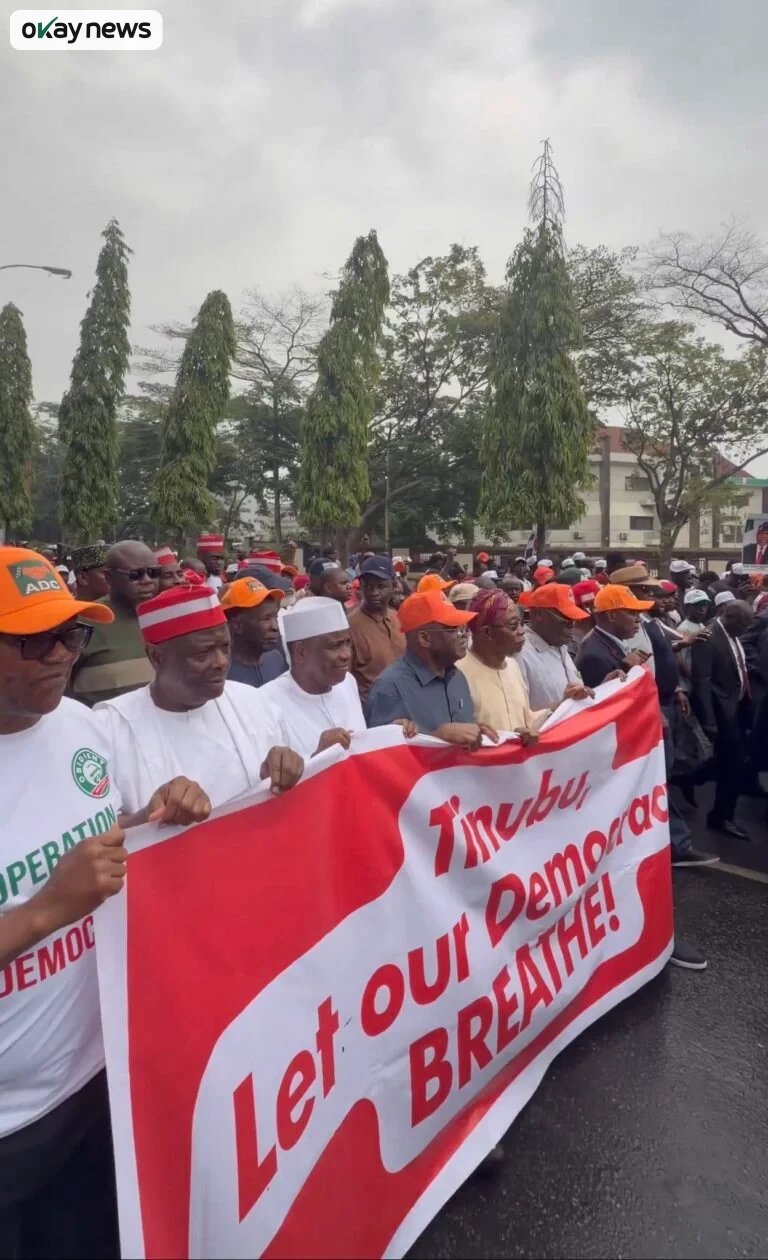
Abuja, Nigeria — Significant political tension gripped the capital city of Nigeria on Wednesday, April 8, 2026, as high-profile opposition figures led a massive demonstration at the Maitama Roundabout. The protest, organized under the tag “#OccupyINEC,” was spearheaded by members of the African Democratic Congress (ADC) to challenge recent administrative decisions made by the Independent National Electoral Commission (INEC).
The gathering featured a rare coalition of prominent Nigerian politicians. Among those present were Atiku Abubakar, the former Vice President of Nigeria; Peter Obi, the former Governor of Anambra State; and Rabiu Kwankwaso, the former Governor of Kano State. Other notable participants included Rotimi Amaechi, the former Minister of Transportation; Rauf Aregbesola, the former Minister of Interior; Aminu Tambuwal, the former Governor of Sokoto State; and Dino Melaye, a former Senator.
This mobilization matters because it represents a unified front against what opposition leaders describe as a threat to multi-party democracy. The protesters expressed deep dissatisfaction with the Independent National Electoral Commission for its refusal to recognize correspondence from the African Democratic Congress leadership following a court dispute. Peter Obi, speaking on behalf of the gathered leaders, emphasized that the demonstration was a necessary stand against the potential emergence of a one-party system in the West African nation.
In a notable display of civil disobedience, participants sang “Arise, O Compatriots!”, which served as Nigeria’s national anthem until it was replaced by the current anthem, “Nigeria, We Hail Thee,” in May 2024. Okay News reports that many demonstrators also carried placards supporting Senator David Mark, indicating a preference for his faction within the party’s National Working Committee (NWC).
The individuals most affected by this standoff are the members of the African Democratic Congress and the broader Nigerian electorate, who face uncertainty regarding party autonomy and internal leadership. Yunusa Tanko, the National Coordinator of the Obidient Movement—a prominent political pressure group—criticized the Independent National Electoral Commission for acting as both an arbiter and a source of friction within opposition parties.
As the protest continues to draw hundreds of supporters, including members of the Kwankwasiyya movement, the next steps remain focused on legal and civic pressure. The opposition intends to continue peaceful rallies until the electoral body addresses their concerns regarding interference in internal party affairs.