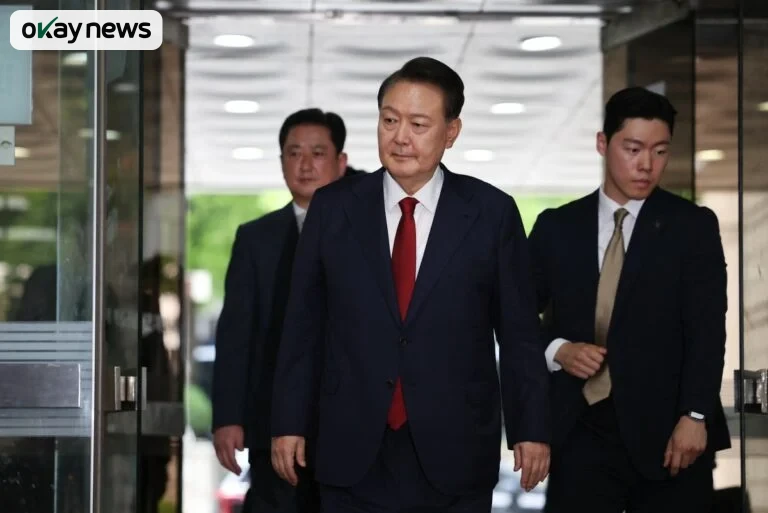
A court in the Republic of Korea, widely known as South Korea, has sentenced former president Yoon Suk Yeol to life imprisonment after finding him guilty of leading an insurrection linked to his declaration of martial law in 2024.
The ruling was delivered on Thursday, February 19, 2026, by the Seoul Central District Court in the capital city of Seoul, South Korea. The decision marks one of the most severe judicial outcomes ever faced by a former democratically elected leader in the country.
Yoon, 65, who previously served as President of South Korea from 2022 until his impeachment, had abruptly declared martial law in a nationally televised address on Tuesday, December 3, 2024. In that broadcast, he said drastic action was required to root out what he described as “anti-state forces” within South Korea’s National Assembly, the country’s legislature.
Okay News reports that the declaration suspended civilian governance and temporarily placed the country under military rule. Armed troops were sent to the National Assembly building in Seoul as lawmakers rushed to convene an emergency session.
Presiding judge Ji Gwi-yeon told the court that Yoon’s actions were aimed at preventing elected lawmakers from carrying out their constitutional duties.
“The court finds that the intention was to paralyse the assembly for a considerable period,” the judge said during the hearing.
She added that, “The declaration of martial law resulted in enormous social costs, and it is difficult to find any indication that the defendant has expressed remorse for that.”
“We sentence Yoon to life imprisonment.”
Under South Korean law, insurrection carries only two possible penalties: life imprisonment or death. Prosecutors had urged the court in January 2026 to impose the death penalty. However, South Korea has maintained an unofficial moratorium on executions since 1997, meaning that a death sentence would in practice result in lifelong incarceration.
Yoon had already been impeached by the National Assembly following the December 2024 crisis. He was later arrested and charged with multiple offences, including insurrection and obstruction of justice. He has consistently denied wrongdoing, insisting that he acted to “safeguard freedom” and restore constitutional order, which he claimed was threatened by what he described as an opposition-led “legislative dictatorship”.
Prosecutors argued that he led an “insurrection” driven by a “lust for power aimed at dictatorship and long-term rule”.
The court also sentenced former defence minister Kim Yong-hyun to 30 years in prison for his involvement in the events surrounding the martial law declaration.
The crisis revived painful memories in South Korea of past military interventions in politics between 1960 and 1980. The country has since been regarded internationally as one of Asia’s most stable democracies, making the 2024 episode particularly alarming for citizens and global partners.
On the day of the verdict, thousands of Yoon’s supporters gathered outside the courthouse in Seoul, holding placards reading “Yoon Great Again” and “Drop the charge against President Yoon”. Police officers in high-visibility jackets formed barricades using buses parked closely together to prevent unrest.
Martial law had been lifted six hours after it was declared, when lawmakers forced their way into the National Assembly building to hold an emergency vote. Staff members barricaded entrances with furniture in an effort to block armed troops from entering.
The declaration sparked immediate protests, unsettled financial markets, and surprised key allies such as the United States.
In a related development, Yoon’s wife, Kim Keon Hee, who served as first lady during his presidency, was sentenced in January 2026 to 20 months in prison on separate charges related to bribes.
Yoon has been held in solitary confinement while contesting several criminal proceedings. With this life sentence, his legal and political legacy now stands defined by the dramatic events of December 2024.