


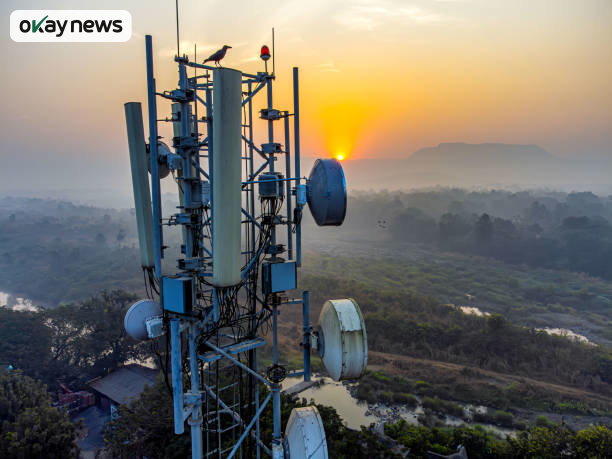
LAGOS, Nigeria — Telecom operators in Nigeria are calling for a new national broadband policy framework, four months after the expiration of the National Broadband Plan (NNBP) 2020-2025, which fell short of its 70% broadband penetration target.
Okay News reports that data from the Nigerian Communications Commission (NCC) shows broadband penetration stood at 51.97% at the close of the five-year plan in December 2025, leaving nearly half of internet users in the country without access to high-speed connectivity.
The President of the Association of Telecommunications Companies of Nigeria (ATCON), Tony Emoekpere, said the country requires a more executable and better-aligned plan than its predecessor. “These plans are important as they set direction, align stakeholders, and attract investment. Every serious digital economy operates with a clear broadband strategy, and ours is no exception. As with all policies, our challenge has been execution,” Emoekpere said.
He said the next broadband policy should place infrastructure rollout at the centre of national planning. “A stronger infrastructure first strategy, alignment between government initiatives and the broader national plan, and deeper local private sector participation are the focus,” he said.
Telecom consultant Adewale Adeoye said the industry requires not just a new plan but one that can be delivered. “A lot of actions highlighted in the NNBP 2020-2025 were not executed, and that explains why many of the targets set could not be met,” Adeoye said.
The NCC said a successor plan is already being developed. Executive Commissioner, Technical Services, Abraham Oshadami, said the regulator is reviewing the performance of the previous plan. “We are carrying out a review of what happened and how it will improve on what NNBP achieved. NNBP has not ended, we are coming up with a new plan,” Oshadami said.
The Chairman of the Association of Licensed Telecommunications Operators of Nigeria (ALTON), Gbenga Adebayo, said some states that officially waived right-of-way fees continue to impose hidden costs including education taxes and highway levies, discouraging investment in fibre deployment.
Operators say structural challenges including right-of-way approval delays, multiple taxation, high infrastructure rollout costs, poor power supply, and weak incentives for expansion into underserved communities constrained the outgoing plan throughout its lifespan.
Emoekpere said some building blocks for the next broadband phase are already emerging, citing Project BRIDGE and a Federal Government push to deploy approximately 7,000 telecom towers into underserved and unserved areas. “What is missing is a coherent framework that ties everything together: fibre, towers, satellite, policy, funding, and execution,” he said.
The NNBP 2020-2025 had set a 50% broadband penetration target for 2023, a figure that was only achieved at the end of 2025. The plan also projected that 70% of telecom subscriptions would be on 4G by 2023. NCC data shows only 52.95% of 179 million active mobile subscriptions were on 4G as of December 2025. The plan’s recommendation that Nigeria have at least one smartphone assembly plant by 2023, to bring entry-level device prices to N18,000 (approximately $12), was not realised. The cheapest smartphone in the market currently sells for more than N100,000 (approximately $65).


 2020-2025, which fell short of its 70% broadband penetration target.)