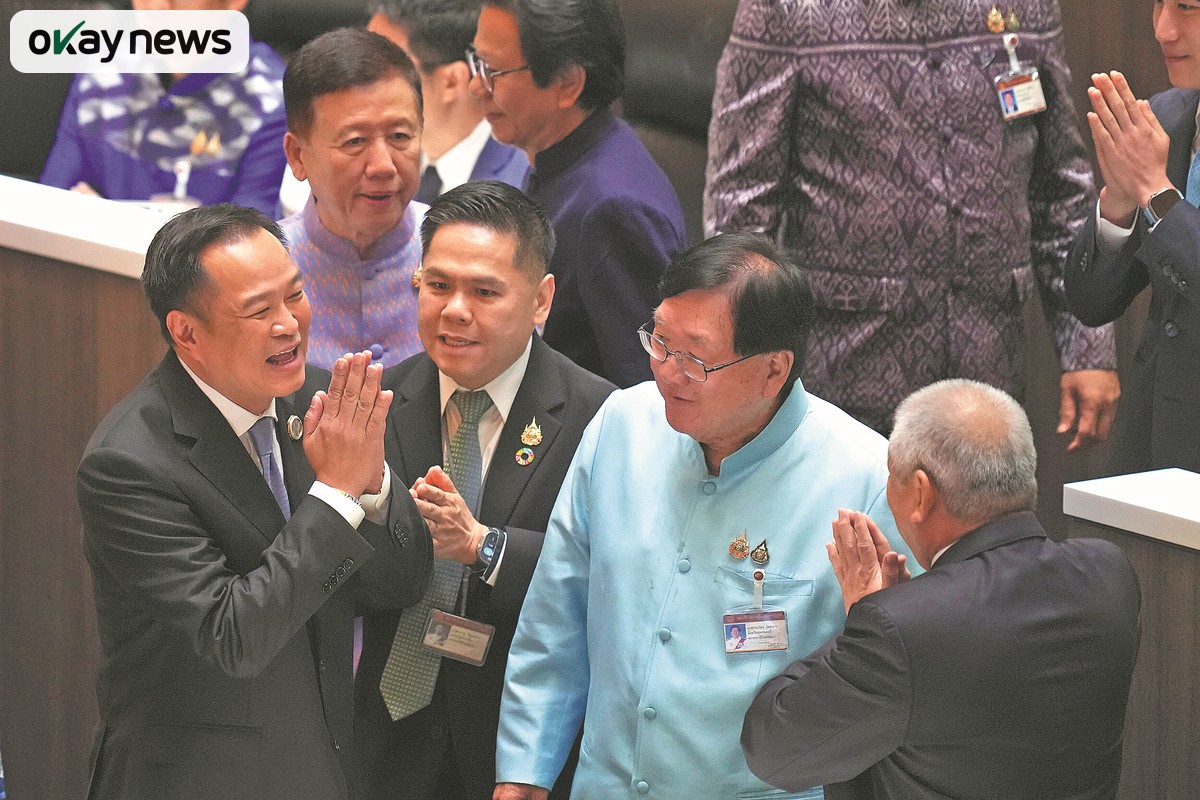
Bangkok, Thailand — Thailand’s newly constituted parliament has elected a new prime minister, securing leadership continuity after the country’s recent general election delivered a decisive outcome.
House Speaker Sophon Zaram announced during a parliamentary session that the newly chosen leader received more than half of the votes cast by lawmakers. According to the official tally, the winner secured 293 votes, defeating the progressive challenger, who received 119 votes, while 86 members abstained.
Speaking ahead of the vote, the new prime minister said, “I hope to remain in my position to serve the people for as long as I can.” He added, “Those who know me understand that whenever there is a problem affecting the public, I will respond immediately to their needs.”
Okay News reports that this election outcome follows a strong performance by the victorious political party, a conservative group aligned with Thailand’s military and monarchy. The party achieved its best electoral result in February 2026, positioning its leader at the forefront of the new government formation.
The new administration faces multiple domestic and international challenges. Thailand, a Southeast Asian country, is grappling with the economic fallout from the ongoing Middle East conflict, slowing domestic growth, and unresolved border tensions with neighbouring Cambodia.
During the 2025 election campaign, the victorious party proposed a hardline security approach following two rounds of deadly clashes along the Thailand-Cambodia border. Measures included constructing a border wall, maintaining closures at all crossings, and recruiting 100,000 volunteer soldiers. These policies helped the party secure the most parliamentary seats.
The coalition government includes a major party linked to former prime minister Thaksin Shinawatra and 14 smaller parties. This alliance provided the support necessary to secure parliamentary approval for the new prime minister.
The 59-year-old prime minister, a wealthy businessman from a prominent construction family, previously assumed office in September 2025 after the former leader was removed by a court ruling over an ethics violation. The controversy stemmed from a leaked phone conversation that drew public criticism and political tension.
The opposition will be led by the reformist People’s Party, which finished second in the election. However, its position may be uncertain as 10 of its newly elected lawmakers, including its leader, face investigations over an ethics dispute related to proposed changes to Thailand’s royal insult law, potentially affecting their political eligibility.
Before the vote, the opposition leader said the party would “utilise this parliamentary stage to effectively communicate with our fellow citizens.”
Thailand’s new government now faces immediate economic challenges. Growth slowed in 2025, with the tourism sector struggling to recover, while neighbouring Vietnam continues to attract increasing foreign investment.
Global developments, particularly rising tensions in the Middle East following Israeli and United States strikes on Iran, have disrupted international markets, contributing to higher fuel costs and supply chain challenges in Thailand.
Political analysts note that while the new prime minister has pledged to “turn this Middle East crisis into an opportunity for Thailand,” more decisive policy measures are needed to address rising costs and economic pressures.
Tensions with Cambodia remain unresolved, even with a fragile ceasefire in place. Disputes over parts of the 800-kilometre shared border persist after the latest clashes in December 2025.
Despite these multiple pressures, public focus has shifted toward the economy. As one political analyst explained, “The economy is now the public’s top priority.”
The months ahead will test the new administration’s capacity to stabilize the economy, address security concerns, and maintain cohesion within its broad coalition.