
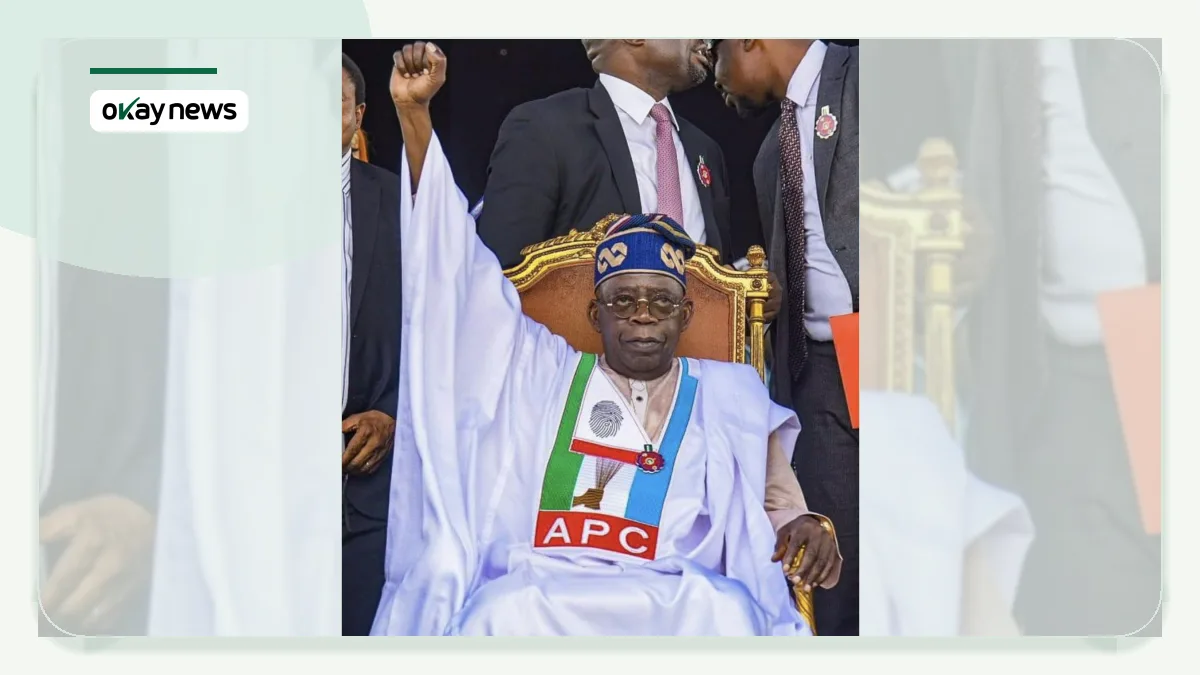
ABUJA, Nigeria — President Bola Ahmed Tinubu has formally accepted the All Progressives Congress (APC) presidential nomination for the 2027 general election, pledging to deepen ongoing economic reforms, strengthen national security, and continue what he described as Nigeria’s path toward long-term stability and prosperity.
Speaking during his nomination acceptance speech, Tinubu described the moment as another milestone in Nigeria’s democratic journey, saying the task before the ruling party was no longer simply about charting a new direction, but consolidating reforms already initiated under his administration.
Okay News reports that the President thanked party leaders, governors, lawmakers, and APC stakeholders for their continued support, while also expressing gratitude to Nigerians whom he said had remained committed to the difficult but necessary reform process.
Reflecting on his emergence as APC presidential candidate in 2022 and eventual victory in the 2023 election, Tinubu said the political and economic landscape had significantly changed over the past four years, citing electoral reforms, fiscal restructuring, and revenue growth as signs of progress.
The President highlighted several achievements of his administration, including the establishment of the Nigerian Education Loan Fund, which he said has disbursed more than N282 billion to over 1.5 million beneficiaries nationwide.
Tinubu also pointed to developments in the power sector, stating that his administration had supplied 2.5 million electricity meters through the Presidential Metering Initiative and established a N4 trillion bond programme to clear verified debts owed to electricity generation and gas companies.
According to him, Nigeria’s electricity generation has at times reached 6,000 megawatts, representing a significant increase from previous levels, while broader reforms are aimed at making the power sector more investable and financially sustainable.
On the economy, Tinubu defended his administration’s decision to remove fuel subsidies and implement exchange rate reforms, arguing that the policies were beginning to stabilise the naira, improve foreign reserves, and strengthen overall macroeconomic management despite global inflationary pressures linked to tensions in the Middle East.
He further listed major infrastructure projects being undertaken across transportation, housing, digital connectivity, and irrigation, including coastal superhighways and the Sokoto-Badagry road corridor.
The President acknowledged that many Nigerians continue to face economic hardship and rising living costs but insisted that his administration remains focused on addressing those realities through practical governance and targeted social investment programmes.
On insecurity, Tinubu admitted that security challenges persist in parts of the country and pledged continued investment in intelligence gathering, surveillance systems, modern security equipment, and stronger collaboration with local communities.
He also urged the National Assembly to urgently amend the Constitution to allow the creation of state police, describing it as a matter of national emergency.
“We will not rest until we restore peace and stability to every corner of our country,” Tinubu declared, adding that the APC government remained committed to building a Nigeria where citizens can live and work without fear.
The President said the next phase of his administration would focus on industrialisation, food sufficiency, energy security, infrastructure expansion, democratic consolidation, and inclusive economic growth.
He also extended an olive branch to political opponents, saying democracy thrives through dialogue, diversity of ideas, and national cooperation rather than division.
Tinubu concluded by pledging to build a more inclusive government that listens to Nigerians and prioritises the interests of all citizens if re-elected in 2027.