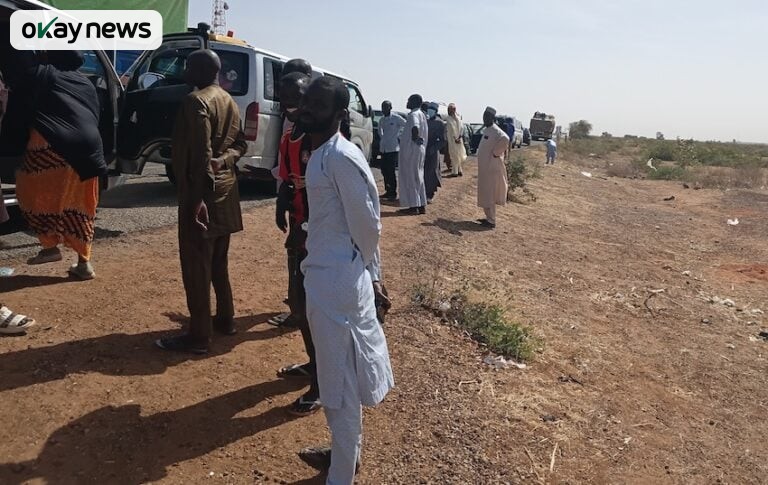
Damaturu, Yobe State, Nigeria – Following a series of attacks across Borno State, the Nigerian Army and the Nigeria Police Force have implemented stringent security measures that now require travelers, including elderly citizens and children, to walk approximately two kilometres on foot when crossing the checkpoint into Yobe State before continuing to Borno State.
Okay News reports that security exercise comes in the wake of recent bomb explosions in Maiduguri, the capital of Borno State, which prompted the Yobe State Police Command to issue an alert ahead of the upcoming Sallah festivities. In a statement released on Tuesday, the command’s spokesperson, Superintendent of Police Dungus Abdulkarim, expressed sympathy for the government and people of Borno State regarding the March 16 attacks, which reportedly occurred at around 6:30 p.m. in multiple locations within Maiduguri.
“The Commissioner of Police has directed Area Commanders, Divisional Police Officers, Tactical Units, and Intelligence Departments to ensure robust security coverage at worship centres, recreational facilities, public parks, and other strategic locations,” the statement read.
Our correspondent, while observing the security measures on Wednesday, noted that travelers are expected to walk to the “Welcome to Damaturu” signpost, a distance of about two kilometres from the checkpoint.
While some travelers praised the initiative as necessary for public safety, many called for a more considerate approach that takes into account the age and health of individuals. Habib Zanna, 69, shared his experience, saying, “This is very harsh. There should be a consideration for at least age and health. The distance is around 2 km. This is us returning to what we left behind. For how long will Nigerians suffer like this?”
Aisha Gambo, another traveler, described the impact on commuters in Nigeria’s North-East. “I have a fracture in my legs, and despite fasting and the long distance, I had to trek almost 2 kilometres. In this modern age, there should be better alternatives, even if it means scanning vehicles and asking everyone to come down and scan or check them, rather than this long walk. This just further compounds the challenges commuters face in Nigeria’s Northeast,” she said.
Sarah Bwala added that the journey exposes travelers to potential risks from militants. “As we are trekking, all I was praying for was that terrorists should not even strike us from the empty, deserted lands we are plying,” she said. She also highlighted the difficulty faced by women carrying children under the hot sun.
The heightened security follows a triple bomb blast in Maiduguri on Monday, March 16, which left 23 people dead and 108 others severely injured. The Borno State Police Command confirmed the attack, stating that thorough investigations are ongoing. Assistant Superintendent of Police Nahum Daso said, “The scenes were immediately secured, cordoned off, and subjected to thorough sweep operations by Police Explosive Ordnance (EOD) Unit Base 13 Maiduguri to rule out the presence of any additional threats.” He also urged residents to remain vigilant.
The Nigerian military had earlier warned of potential deployment of multiple suicide bombers by Boko Haram, a terrorist group, in Maiduguri, urging residents to avoid crowded places. Lieutenant Colonel Sanni Uba, Media Information Officer of the Northeast Joint Taskforce Operation Hadin Kai, confirmed that militants targeted crowded public areas in an attempt to inflict mass casualties and create panic. “Preliminary information further indicates that the terrorists may have deployed multiple suicide bombers into Maiduguri with the intention of carrying out coordinated suicide bombings at crowded locations. Security forces have therefore intensified surveillance, patrols, and counter-IED measures across the metropolis to track down any remaining suspects and prevent further attacks,” he stated.