
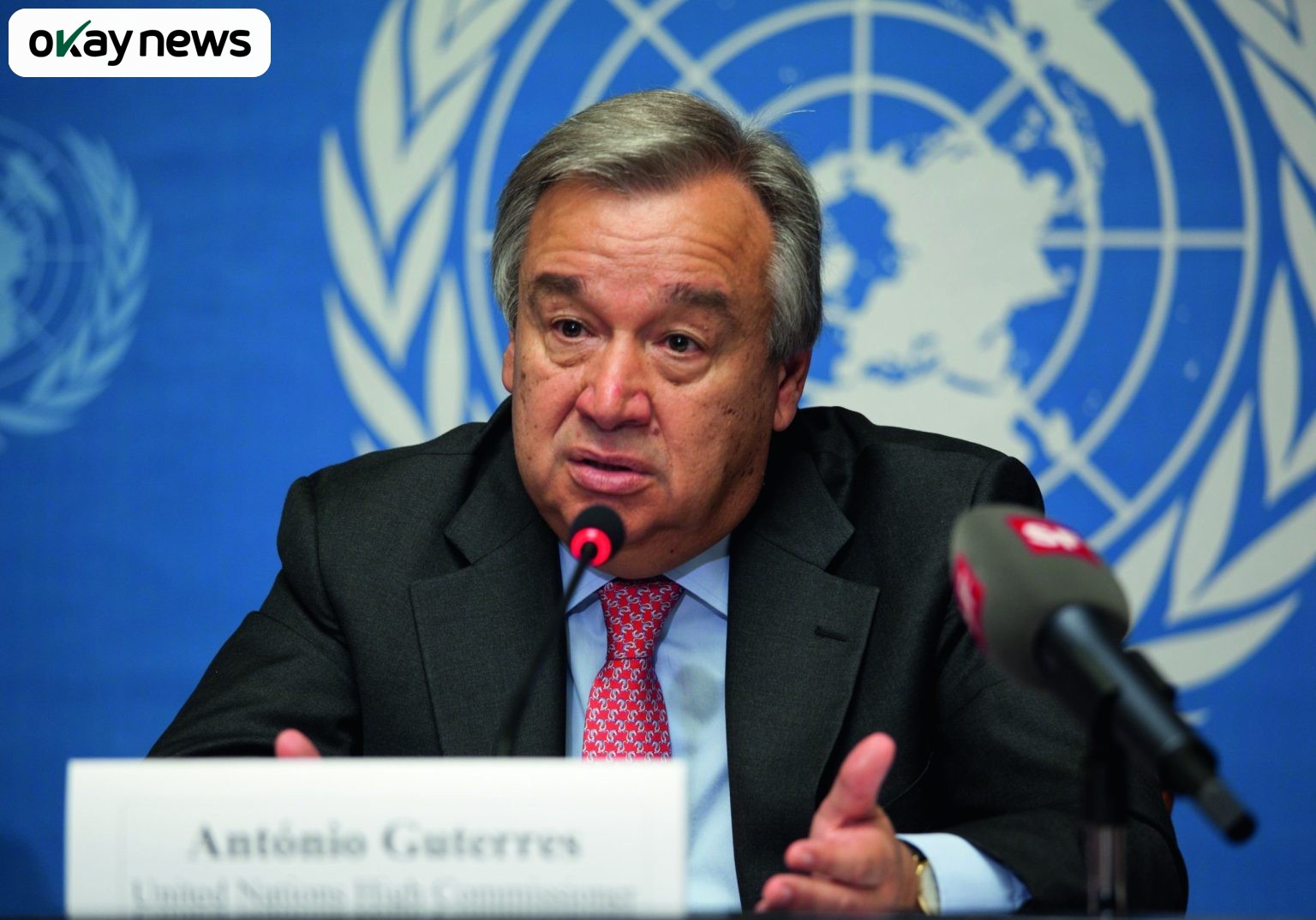
United Nations Secretary General António Guterres, the top official of the United Nations, has warned world leaders against trying to solve global problems through unilateral actions or by allowing one dominant power to dictate outcomes.
Speaking at United Nations Headquarters in New York City, United States, Guterres said the world is facing rising instability and needs stronger cooperation built around shared responsibility and effective international institutions.
He described 2026 as a year “already shaping up to be a year of constant surprises and chaos,” and said reckless decisions in different parts of the world are triggering dangerous consequences.
Okay News reports that his remarks were contained in a United Nations update issued on Thursday, 29 January 2026, where he set out priorities for what he described as his final year agenda.
Guterres also raised concerns about how power is shifting from governments to private technology companies. He warned that when tools that influence how people behave, how elections are shaped, how markets work, and even how conflicts unfold operate without strong rules, the result is not progress.
“When technologies that shape behaviour, elections, markets, and even conflicts operate without guardrails, the reaction is not innovation, it is instability,” he said.
The United Nations chief stressed that the major challenges facing the world cannot be solved by any single country imposing its will. He also warned against a world divided between rival blocs.
“Global problems will not be solved by one power calling the shots. Nor will they be solved by two powers carving the world into rival spheres of influence,” he said.
Instead, he called for a faster move toward a multipolar world, where influence is shared across many countries and regions through partnerships. He said this kind of global balance must be supported by strong multilateral institutions, meaning international bodies where countries work together under agreed rules.
“For multipolarity to generate equilibrium, prosperity and peace, we need strong multilateral institutions where legitimacy is rooted in shared responsibility and shared values,” he said.
Guterres also pointed to the United Nations Charter, the founding document agreed by member states after World War Two, as a guide for today’s crises. He said institutions may need updates, but the core values behind the organisation remain essential for lasting peace and justice.
“Structures may be out of date, but values are not,” he said, adding that the principles in the charter were designed as foundations for “lasting peace and enduring justice.”
Outlining priorities for the year, Guterres linked peace efforts to development and institutional reform, saying the United Nations is pushing for “just and sustainable peace rooted in international law.” He said peace should address the root causes of conflict and remain stable beyond the signing of agreements.
He also highlighted ongoing calls to reform the United Nations Security Council, the body responsible for major decisions on international peace and security. In addition, he spoke about the need to accelerate progress on the Sustainable Development Goals, the global targets adopted by countries to reduce poverty, improve health and education, and protect the environment by 2030.
On climate and technology, he said countries facing climate disasters need fair support, and he renewed calls for global governance frameworks for artificial intelligence (AI), the fast-growing technology used in systems that can analyse information and make decisions.
“As we begin this year, we are determined to choose actions that generate concrete and positive reactions,” Guterres said, adding that the world needs “reactions of peace, of justice, of responsibility, and of progress” during difficult times.