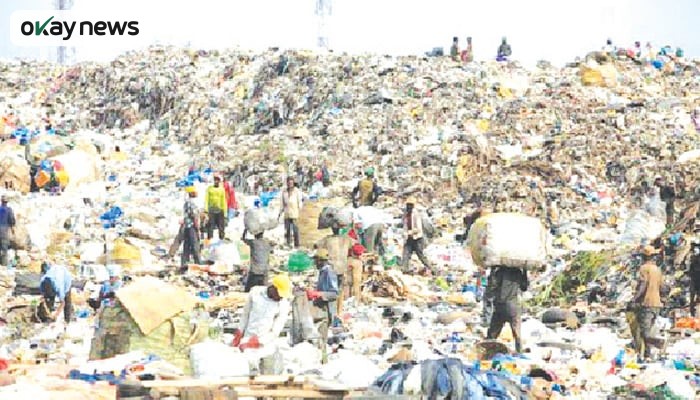
The Lagos State Government has announced plans to permanently close down several major dumpsites that have reached the end of their operational lifespan, as part of a comprehensive environmental reform aimed at strengthening waste management and improving sustainability across the state.
The Commissioner for the Environment and Water Resources, Tokunbo Wahab, disclosed this on Wednesday in a statement shared via his official X handle after a meeting with all 57 Local Government and Local Council Development Area (LCDA) chairmen in the state.
According to Wahab, the decision is part of the government’s broader environmental agenda to create a cleaner and flood-free Lagos through coordinated efforts between state and local authorities.
“We are decommissioning landfills like Olusosun and Solous 3 that have outlived their usefulness, while ensuring that functional ones like Epe remain active and efficient,” he stated.
The meeting, which took place at the Ministry of the Environment and Water Resources, was attended by key government officials including the Commissioner for Transportation, Oluwaseun Osiyemi; Commissioner for Local Government, Chieftaincy Affairs and Rural Development, Bolaji Roberts; Secretary to the State Government, Bimbola Salu-Hundeyin; and the Special Adviser on the Environment, Olakunle Rotimi-Akodu, alongside Permanent Secretaries and heads of relevant agencies.
Okay News reports that the state’s current environmental strategy focuses on transitioning from traditional waste dumping to modern waste processing, recycling, and energy recovery systems aimed at improving urban sanitation and reducing carbon emissions.
Wahab stressed that the administration of Governor Babajide Sanwo-Olu remains committed to environmental renewal, but emphasized that progress requires active participation from local governments and community members.
“Our message was clear: environmental management begins at the grassroots. We must all work together to build a cleaner, flood-free Lagos where waste becomes a resource rather than a burden,” he said.
He charged council chairmen to ensure proper waste collection and disposal within their jurisdictions, while also enforcing the ban on street trading and indiscriminate dumping of refuse.
“The state is building resilient drainage and flood control infrastructure; our Local Governments must mirror this commitment in their own communities,” Wahab added.
The commissioner reaffirmed that sustainable environmental management remains a shared responsibility among all tiers of government, noting that collaboration and transparency are key to achieving long-term environmental health for Lagos.
“The State Government will continue to lead from the front, but true progress will come when all tiers of government work hand in hand,” Wahab stated.