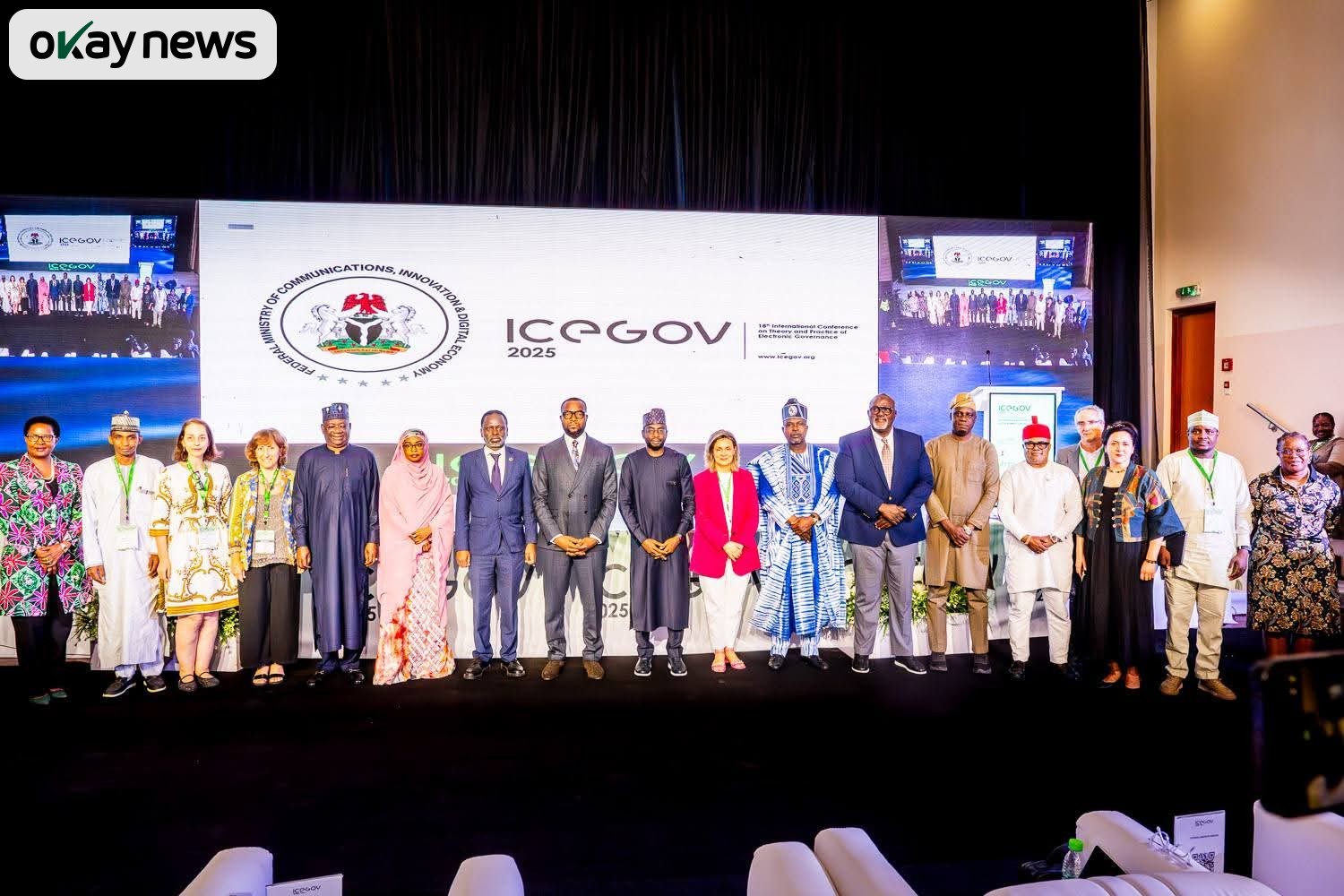
Nigeria has reaffirmed its commitment to advancing Africa’s digital transformation through innovation, research, and collaborative governance at the 18th edition of the International Conference on Theory and Practice of Electronic Governance (ICEGOV) 2025.
The event, which took place at the Shehu Musa Yar’Adua Centre in Abuja, Nigeria’s capital, brought together global experts, policymakers, and industry leaders to discuss how technology can strengthen governance and promote sustainable development.
Led by the Minister of Communications, Innovation and Digital Economy, Dr. Bosun Tijani, and the Director-General of the National Information Technology Development Agency (NITDA), Kashifu Inuwa CCIE, Nigeria declared its readiness to lead in shaping the future of digital governance.
ICEGOV, established in 2007, is a global annual gathering that connects academia, governments, civil society, and private sectors to share best practices in electronic governance. The 2025 edition, themed “Shaping the Future of Digital Governance through Cooperation, Innovation, and Inclusion”, was co-chaired by the Rector of the United Nations University and United Nations Under-Secretary-General, Prof. Tschilidzi Marwala, alongside Dr. Tijani.
Prof. Marwala, in his keynote address, called for the responsible and inclusive development of artificial intelligence (AI), stressing that the technology must “work equally for all people, including Africans,” if it is to achieve its full potential as a tool for global progress.
He said, “Artificial intelligence is shaping many areas of our lives, but it must be designed so that it does not leave anyone behind. AI will remain suboptimal until it works equally for all people, including the people of Nigeria and, by extension, the African continent.”
According to him, developing AI requires a delicate balance between transparency and security, innovation and accountability. He added that “democratisation of AI means not only that people can freely use AI but also that they can collectively decide how it is to be used.”
Prof. Marwala concluded by urging world leaders and technologists to view AI as “a moral responsibility that demands cooperation across nations to ensure technology strengthens humanity rather than divides it.”
In his own remarks, Dr. Tijani emphasised that digital innovation must be guided by ethics, research, and inclusivity.
“Nigeria stands at the intersection of innovation, youth, and digital transformation. The state of a society reflects the ideas that dominate it. When good ideas strike, nations prosper; when bad ideas prevail, nations decay,” he said.
He introduced the “Source Balance Ratio,” a model highlighting how diverse inputs from government, academia, civil society, and the private sector shape effective public policy.
According to the Minister, “If our ideas are driven solely by profit or short-term politics, we end up with regulations that react to innovation rather than guide it.”
Okay News reports that Dr. Tijani also called for stronger research-driven policymaking, linking academic institutions with governance to foster evidence-based solutions. He stated that platforms such as ICEGOV play a vital role in ensuring that innovation serves humanity responsibly.
“Digital technologies are no longer just economic tools; they reshape our societies and our citizenship. Our responsibility is to ensure that innovation is guided by ethics, inclusivity, and the public interest,” he concluded.
Echoing the Minister’s stance, NITDA Director-General Kashifu Inuwa CCIE described ICEGOV 2025 as “a remarkable milestone in Nigeria’s journey toward becoming a digital governance powerhouse.”
He noted that Nigeria’s hosting of the event followed the success of its participation in ICEGOV 2024 held in South Africa, where Dr. Tijani advocated for deeper investments in digital research and technology.
“Honourable Minister said he wants us to host workshops at the ICEGOV 2024 because he believes in research, and that if we really want to build a robust and sustainable economy, especially in the digital era, we need to invest heavily in deep research, especially in deep tech,” Inuwa said.
He further explained that the Ministry’s strategic plan — Accelerating the Nation’s Collective Prosperity through Technical Efficiency — is anchored on five pillars: Knowledge, Policy, Infrastructure, Trade, and Innovation, Entrepreneurship & Capital.
Among Nigeria’s key initiatives, he highlighted the National Digital Literacy Framework, designed to equip every citizen with essential digital skills from early education to adulthood. He also cited collaborations with the Ministry of Education to integrate digital literacy into the school curriculum and with the Office of the Head of the Civil Service of the Federation to train all public servants — with over 24,000 already enrolled.
“The 3 Million Technical Talent (3MTT) initiative aims to equip Nigerians with globally relevant digital skills, extending to market traders, transport workers, senior citizens, and faith-based groups,” he noted.
According to Inuwa, “Digital transformation is not just about technology. It’s about improving how we serve our citizens, and governance must meet citizens where they are, which is online.”
He also disclosed ongoing work on Nigeria’s Digital Public Infrastructure (DPI), including a national data exchange platform and a Centre of Excellence for DPI, both aimed at strengthening Nigeria’s digital governance systems.
“Our goal is to build the capacity, infrastructure, and right policies for Africa’s digital self-determination. ICEGOV gives us the platform to learn, share, and shape that future together,” Inuwa concluded.
The event featured goodwill messages from notable dignitaries including the Minister of State for Education, Prof. Suwaiba Said Ahmad; the Head of the Civil Service of the Federation, Mrs. Didi Esther Walson Jack, represented by Mrs. Fatima S.T. Mahmood; the Chairman, Senate Committee on ICT & Cybersecurity, Senator Shuaibu Afolabi Salisu; and the Chairman, House Committee on ICT, Hon. Stanley Adedeji.
They commended Nigeria’s leadership in advancing digital governance and innovation, describing ICEGOV 2025 as “a crucial platform for deepening global dialogue on digital ethics, policy, and development.”
Speakers at the conference emphasised the importance of aligning Nigeria’s national digital strategy with global best practices in artificial intelligence governance, cybersecurity, and emerging technologies.
They concluded that Nigeria’s digital economic transformation can only be sustained through continuous collaboration, capacity-building, and the development of resilient digital public infrastructures that promote transparency, interoperability, and trust.