Stakeholders across Nigeria’s health sector have renewed calls for stronger gender equity in healthcare leadership, stressing that women must be more actively represented in decision-making positions if the country’s health system is to become resilient and effective.
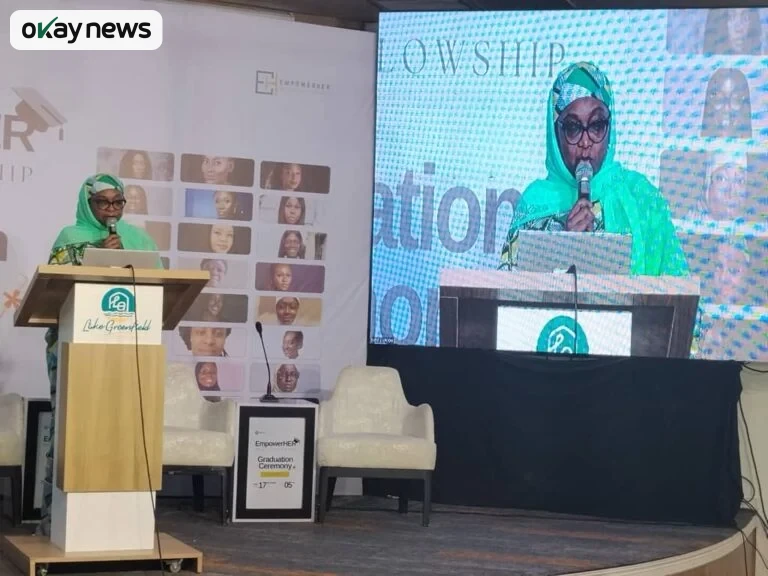
The renewed advocacy took place on Wednesday, December 17, 2025, in Abuja, Nigeria’s federal capital, during the graduation ceremony and gala night of the EmpowerHer Fellowship, a leadership development programme organised by Women in Global Health Nigeria. The event brought together health professionals, policy advocates, researchers, and development partners.
Okay News reports that speakers at the event consistently highlighted the contradiction between women’s dominance in the health workforce and their limited presence in leadership roles across hospitals, institutions, and policy-making platforms.
According to World Health Organisation, the global health and care sector remains one of the largest sources of employment worldwide, particularly for women. Data from 2020 shows that women accounted for 67.2 per cent of workers in the sector, a figure that underscores the scale of women’s contribution to health systems globally.
The global health body further noted that the sector’s attractiveness to women in paid employment presents a major opportunity to advance women’s economic empowerment. However, it stressed that this potential can only be fully realised if women health workers are adequately valued, supported, protected, and promoted in line with its Global Strategy on Human Resources for Health: Workforce 2030 and the Working for Health 2022–2030 Action Plan.
The EmpowerHer Fellowship is a one-year fully funded leadership programme, with only 24 women selected for its inaugural cohort. The fellowship was structured around four major training streams, including advocacy, research, leadership development, personal branding, and the strategic use of social media for influence. While all participants received advocacy training, they were later grouped into specialised tracks to deepen their expertise.
Participants in the programme included researchers, university lecturers, health advocates, and senior health professionals, reflecting the fellowship’s goal of breaking persistent gender barriers in healthcare leadership. Beyond formal training, the initiative also prioritised mentorship, professional visibility, and confidence-building.
In her welcome address, the Co-founder and Chapter Lead of Women in Global Health Nigeria, Dr. Peju Adeniran, said the fellowship was created to confront the continued exclusion of women from leadership spaces.
“This fellowship responds to the status quo in which not enough women have their voices in the room. When the voices of women are not in the room, we fail to utilise at least 50 per cent of our talent pool. We miss the perspectives, viewpoints, and unique contributions that women bring.
“Our response through this fellowship is to support women who are already doing the work but may lack clarity or confidence about how to amplify their impact. This platform helps them leverage their work. This is a place where we see you, where we invite you to see yourself, and where we support you to build confidence,” she said.
Delivering the keynote address, the Senior Country Director of Pathfinder International Nigeria, Dr. Amina Dorayi, charged the fellows to embrace resilience, vision, and vocal leadership, stressing that women’s leadership in healthcare is essential to Nigeria’s future.
“Tonight is not just a celebration; it is a declaration that women’s leadership in health is not optional. It is essential to the strength, resilience, and future of Nigeria’s health system,” she stated.
She cautioned against equating resilience with silence, adding: “True resilience is not about enduring injustice quietly. It is about holding your ground when it would be easier to step back, refusing to compromise your values, and returning stronger and more prepared.”
Also speaking, the Project Officer at Women in Global Health Nigeria, Bukola Shaba, explained that the EmpowerHer Fellowship was designed to confront the persistent leadership gap faced by women in global health, despite their dominant presence in service delivery.
“Women deliver about 70 per cent of healthcare services globally, yet they are missing from leadership positions. The EmpowerHer Fellowship was created to raise a new crop of visible, confident, and well-equipped women leaders in global health,” she said.
Although the graduation marked the end of the formal training phase, Shaba noted that mentorship would continue into the first quarter of the coming year, with all fellows remaining active members of the organisation.
She added that gender inequity extends beyond leadership roles to career progression challenges faced by community health workers, who are predominantly women but often lack structured advancement pathways.
“One of the areas we focused on from the beginning was community health workers. We realised that most community health workers are women, yet many of them do not have clear paths to leadership.
“We carried out advocacy visits to the National Primary Health Care Development Agency and engaged senior leaders to explore how these women can be better integrated and trained. We also organised training sessions for community health workers.
“Policy change does not happen overnight, but consistent advocacy, collaboration, and awareness can shift the narrative. When women are empowered and equipped, health systems become stronger and more equitable,” she stated.
One of the fellows, veterinarian and One Health advocate, Dr. Bolanle Akanbi, said the fellowship expanded her capacity to drive social impact beyond her primary profession.
“I am interested in women’s health, and the fellowship has equipped me to combine my baseline profession with collaborations involving medical professionals, microbiologists, journalists, and others to create more impact in women’s welfare, mental health, and reproductive health.
“I am not only treating animals; I also work with women who rear animals to educate them on how infectious diseases can spread and how proper animal care can improve their well-being, income, and mental health,” she added.